
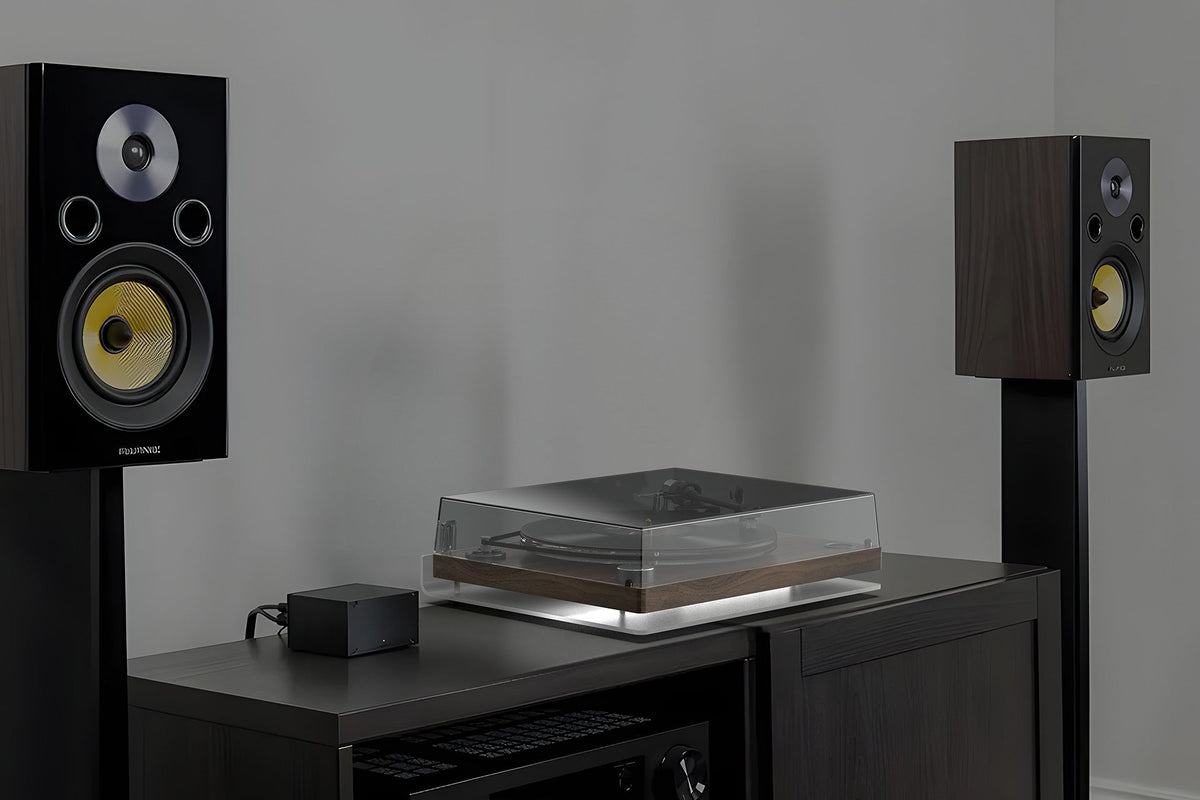
When you buy a modern turntable, you may notice something that would have seemed strange a few decades ago:
It can have both Bluetooth and RCA.
So which one should you use?
The answer is not simply "Bluetooth is newer" or "RCA sounds better."
Both connections have a place in a modern vinyl setup. Bluetooth prioritizes convenience and flexible placement, while RCA keeps the connection wired and works naturally with traditional stereo equipment.
In many cases, the best turntable is not one that makes you choose between them.
It is one that lets you use either.
Bluetooth vs. RCA: What's the Difference?
At the most basic level:
Bluetooth sends audio wirelessly.
RCA sends audio through a physical cable.
A Bluetooth turntable with transmission capability can send vinyl audio to compatible Bluetooth speakers, headphones, or other receiving equipment.
An RCA connection uses analog audio cables to connect the turntable to compatible powered speakers, amplifiers, phono stages, or other audio equipment.
The difference is less about the music itself and more about how the signal gets from the turntable to the rest of the system.
Why Choose Bluetooth?
The biggest advantage is obvious:
No audio cable between the turntable and the wireless receiving device.
That can make a setup considerably easier to arrange.
Imagine your turntable sitting on a console against one wall while your preferred Bluetooth speaker works better somewhere else in the room.
With RCA, the cable has to connect the two.
With Bluetooth, placement becomes much more flexible.
Bluetooth makes sense when you want:
A cleaner setup
Fewer visible cables can make a small room look much less cluttered.
Easy headphone listening
A compatible Bluetooth turntable can transmit audio directly to Bluetooth headphones.
Flexible speaker placement
Your speaker does not have to sit right next to the turntable.
A simple system
Bluetooth can reduce the number of components required for casual listening.

Why Choose RCA?
RCA is old.
That does not make it obsolete.
It remains one of the most practical ways to connect a turntable to a home audio system.
With a wired connection, the signal travels directly through the cable to the next component in the system.
That makes RCA particularly useful when you already own:
- an amplifier
- a receiver
- powered speakers
- a dedicated phono stage
- a traditional stereo system
For listeners who enjoy building and adjusting their own audio chain, wired connectivity also provides more control over the individual components.
Does RCA Sound Better Than Bluetooth?
This is where things become more nuanced.
A wired RCA connection avoids the wireless encoding and decoding involved in Bluetooth transmission.
Bluetooth audio, meanwhile, depends on the transmitter, receiver, supported codec, and implementation.
So it would be fair to say that RCA and Bluetooth are not identical signal paths.
But that does not mean RCA will always sound dramatically better in every real-world system.
The actual result depends on the complete setup.
A good Bluetooth system paired with capable headphones or speakers can sound very enjoyable.
A poorly configured RCA system can sound disappointing.
The question is not simply:
"Which connection is better?"
It is:
"Which connection makes more sense for my system?"
Bluetooth Is About Convenience. RCA Is About Connection.
A useful way to think about the difference is:
Bluetooth = flexibility
RCA = directness
Bluetooth is excellent when you want to remove cables from the room.
RCA is excellent when you want a straightforward wired link between your components.
Neither connection is inherently more "authentic" for vinyl.
The record is still being played by the turntable either way.

What About a Phono Preamp?
This is an important detail because people sometimes assume that Bluetooth and RCA completely determine the setup.
They don't.
A turntable's phono signal requires appropriate phono-stage processing before it can be sent to a normal line-level input.
Depending on the turntable, that phono stage may be built into the turntable, built into an amplifier, or provided by an external phono preamp.
With RCA, this is something you need to understand when connecting the system.
With Bluetooth, the turntable handles the necessary internal processing for the wireless transmission according to its design.
So before deciding between Bluetooth and RCA, first understand the signal path of the actual turntable you are using.
Bluetooth vs. RCA for Different Listening Styles
Choose Bluetooth if you:
- already own Bluetooth speakers
- prefer wireless headphones
- want fewer cables
- have limited space
- frequently move your listening setup
- want a simple modern system
Choose RCA if you:
- already own an amplifier
- use passive speakers
- have powered speakers with RCA inputs
- want a traditional wired setup
- prefer keeping the signal path wired
- are building a system around separate components
Choose both if you:
- want flexibility
- may upgrade your system later
- use headphones sometimes and speakers at other times
- want wireless convenience without giving up wired connectivity
For many modern listeners, this third option is the most useful.
Can You Switch Between Bluetooth and RCA?
It depends on the specific turntable and how its outputs are designed.
Some models support both, allowing you to build different systems around the same turntable.
For example, you might use:
Bluetooth → headphones
for a late-night listening session,
then switch to:
RCA → powered speakers
when you want to listen in the room.
The exact switching process varies by model, so check the manufacturer's instructions.
Which Connection Is Better for a Small Apartment?
Bluetooth often has the practical advantage.
A small room can quickly become crowded with equipment and cables. Wireless audio allows more freedom over where the speaker or headphones are positioned.
That does not mean RCA is a bad choice.
A pair of compact powered speakers connected directly by RCA can still produce an extremely clean setup.
In fact, a short RCA connection can be simpler than troubleshooting a wireless connection.
Again, your room and your equipment matter more than the label.
Which Connection Is Better for a Traditional Hi-Fi System?
RCA usually makes more sense.
If your system already includes a phono stage, amplifier, and passive speakers, there may be little reason to introduce Bluetooth.
The wired connection fits naturally into the existing chain.
For listeners who enjoy upgrading individual components, RCA also keeps the system modular.
You can change the amplifier without changing the speaker.
You can upgrade the phono stage without replacing the turntable.
You can experiment with different speakers while keeping the same source.
That flexibility is one reason wired connections remain so important.
AudioKeeper GENESIS-V2: Why Having Both Matters
The AudioKeeper GENESIS-V2 offers both Bluetooth transmission and RCA connectivity, which means you don't have to lock yourself into one type of setup.
You can use Bluetooth with a compatible wireless speaker or headphones when convenience is the priority.
Or you can use RCA to connect the turntable to compatible powered speakers or a more traditional audio system.
That is useful because listening habits change.
You may want a simple wireless setup today and a more traditional stereo system later.
A turntable with both options can grow with you.
So, Which Is Better?
There is no universal winner.
Choose Bluetooth for convenience.
Choose RCA for a traditional wired system and greater control over the physical signal chain.
Choose a turntable with both when you want the freedom to do either.
The decision becomes much easier once you stop treating Bluetooth and RCA as competing technologies.
They are simply two different ways to connect the same source to the rest of your system.
And in 2026, having both can be less about choosing sides and more about keeping your options open.
After all, a good vinyl setup should adapt to the way you listen—not the other way around.







Leave a comment
All comments are moderated before being published.
This site is protected by hCaptcha and the hCaptcha Privacy Policy and Terms of Service apply.