
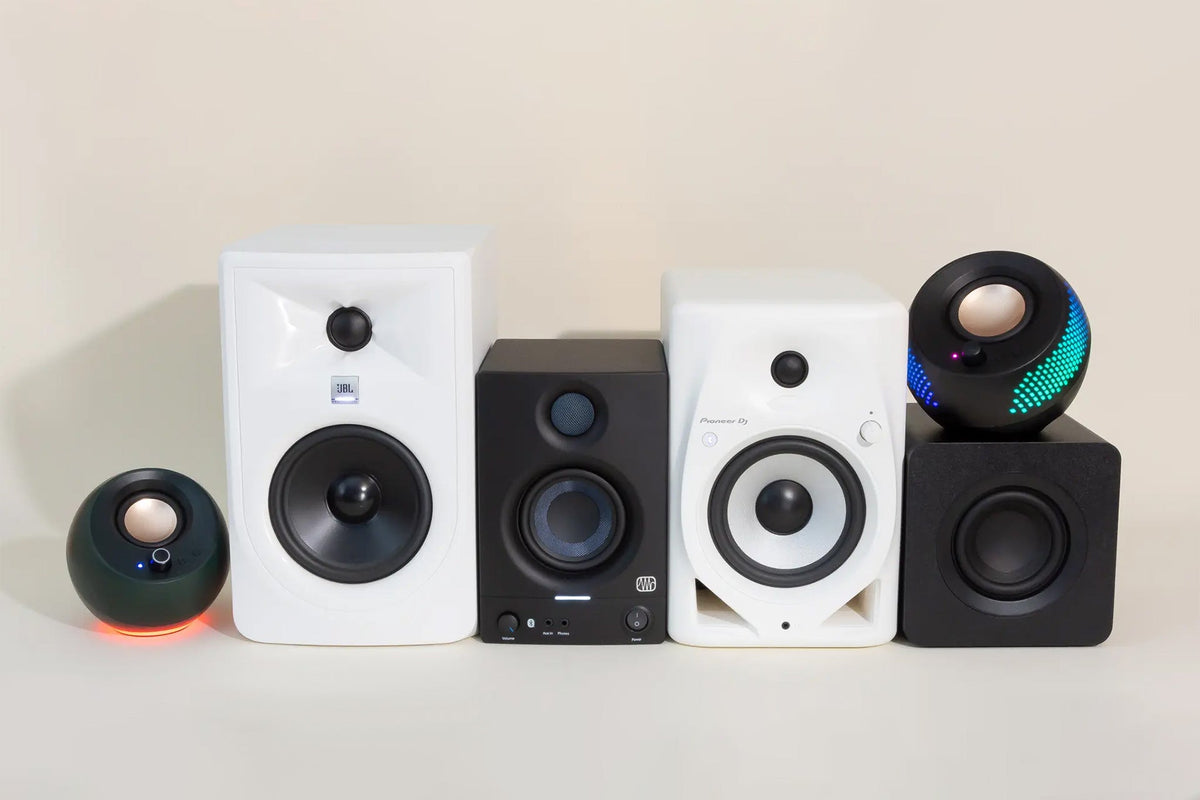
Choosing speakers for a turntable sounds simple until you discover there are two very different ways to build the system:
Powered speakers have amplification built in.
Passive speakers need a separate amplifier.
That one difference affects the size, cost, flexibility, and complexity of your entire vinyl setup.
So which should you choose?
For a simple home system, powered speakers are often the easier choice. For listeners who want to build and upgrade a traditional stereo system over time, passive speakers can offer more flexibility.
Neither is automatically better.
What Are Powered Speakers?
Powered speakers have an amplifier built into the speaker cabinet.
That means you can often connect a suitable turntable directly to them without adding a separate power amplifier.
A simple setup might look like:
Turntable → powered speakers
Depending on the turntable and speakers, the connection may use RCA or another compatible input.
Powered speakers can also include additional features such as Bluetooth, USB, or multiple inputs, making them useful beyond a vinyl-only system.
Why people like powered speakers
They offer a straightforward setup with fewer separate components.
That makes them particularly appealing for:
- first-time vinyl listeners
- apartments and smaller rooms
- desks and compact listening spaces
- people who want fewer cables
- listeners who don't want to choose a separate amplifier
For many people, that simplicity is the main attraction.
What Are Passive Speakers?
Passive speakers do not contain their own power amplifier.
They need an external amplifier or receiver.
The typical arrangement is:
Turntable → amplifier → passive speakers
This adds another component, but it also gives you more control over the system.
You can choose the amplifier separately from the speakers and upgrade either one later.
That makes passive speakers popular with listeners who enjoy building a more traditional hi-fi system.
Powered vs. Passive: The Key Differences
| Powered Speakers | Passive Speakers | |
|---|---|---|
| Built-in amplifier | Yes | No |
| Separate amplifier required | No | Yes |
| Setup complexity | Lower | Higher |
| Number of components | Fewer | More |
| Upgrade flexibility | Moderate | High |
| Cable requirements | Usually simpler | More extensive |
| Best for | Simple, compact systems | Customizable hi-fi systems |
The difference is not really about which type is "more advanced."
It's about where you want the complexity to live.
With powered speakers, more of the system is built into the speaker.
With passive speakers, you choose more of the system yourself.
Which Sounds Better?
There is no universal answer.
It would be misleading to say that passive speakers automatically sound better because they use a separate amplifier.
Likewise, powered speakers are not automatically lower quality because the amplifier is inside the cabinet.
Sound depends on the complete system:
- speaker design
- amplifier quality
- turntable
- cartridge and stylus
- room
- speaker placement
- source signal
- listening preferences
A well-designed powered speaker system can sound excellent.
A well-designed passive system can also sound excellent.
The better question is which system gives you the performance and flexibility you actually need.

Why Choose Powered Speakers for Vinyl?
Simplicity
A powered pair can turn a potentially complicated system into just two main components:
Turntable + speakers
That is a big advantage for anyone who wants to spend more time listening and less time configuring equipment.
Smaller footprint
Without a separate amplifier or receiver, powered speakers can work well in smaller spaces.
Easier first setup
New vinyl listeners don't have to learn how to match an amplifier with passive speakers before they can start listening.
Built-in features
Some powered speakers offer Bluetooth and multiple inputs, allowing them to work with phones, computers, TVs, and other sources as well as a turntable.
This can make them particularly useful in a modern home.
Why Choose Passive Speakers?
More flexibility
With passive speakers, the amplifier and speakers are separate components.
You can change one without necessarily replacing the other.
Easier system upgrades
If you later want a more capable amplifier, you can replace the amplifier while keeping your speakers.
Likewise, you can upgrade your speakers while keeping the same amplifier if the combination remains appropriate.
Traditional hi-fi experience
For listeners who enjoy building a system piece by piece, passive speakers provide more opportunities to experiment.
More component choices
There is a huge range of passive speakers and amplifiers available, which can make it easier to tailor a system to your preferences and room.
The trade-off is that you have more decisions to make.
Do Powered Speakers Need a Phono Preamp?
Sometimes.
It depends on the turntable.
If the turntable has a built-in phono preamp and provides the appropriate line-level output, you may be able to connect it directly to compatible powered speakers.
If it does not, you may need an external phono stage.
The same basic principle applies to passive systems.
Before buying equipment, determine where the phono stage will be handled.
That one check can save you from buying a perfectly good set of speakers that cannot accept the signal coming from your turntable without additional equipment.
Can You Use Bluetooth With Powered Speakers?
Yes, depending on the equipment.
There are several possible arrangements:
Turntable → Bluetooth → powered Bluetooth speakers
or:
Turntable → RCA → powered speakers
The wireless option can reduce visible cabling, while the wired option keeps the connection physical.
A turntable with both Bluetooth transmission and RCA output gives you more freedom to choose.
The AudioKeeper GENESIS-V2 follows this approach, allowing listeners to connect wirelessly to compatible Bluetooth audio equipment or use RCA with a suitable wired system.
What About Passive Speakers With a Bluetooth Turntable?
That can work too—but Bluetooth does not remove the need for an amplifier.
The setup might be:
Turntable → Bluetooth → Bluetooth-enabled amplifier → passive speakers
or a more traditional:
Turntable → RCA → amplifier → passive speakers
The key point is simple:
Passive speakers still need amplification.
Bluetooth changes the connection between components. It does not provide the power required to drive passive speaker drivers by itself.

Which Is Better for a Small Apartment?
Powered speakers often make more sense.
They take up less space, require fewer components, and can create a clean setup without a separate amplifier.
A compact turntable paired with a pair of powered bookshelf speakers can provide a genuine stereo listening experience without taking over the room.
That said, a carefully chosen passive system can also work beautifully in a small space.
Size is only one part of the equation.
Which Is Better for Someone Who Loves Upgrading?
Passive speakers have the advantage here.
If you enjoy experimenting with different amplifiers, speakers, and other components, a separate system gives you more options.
You can build gradually instead of buying everything at once.
For example:
Start: turntable + integrated amplifier + passive speakers
Later: upgrade the speakers
Later still: upgrade the amplifier
That modular approach is one of the biggest reasons people remain interested in traditional hi-fi systems.
Which Should Beginners Choose?
For many beginners, powered speakers are the simpler starting point.
A setup like:
Turntable + powered speakers
can be easy to understand and relatively compact.
But "beginner" doesn't automatically mean "powered."
If you already know that you want to build a traditional stereo system, starting with passive speakers and an amplifier can make more sense.
The best choice is the one that matches the system you actually want—not the system someone says a beginner is supposed to have.
Powered or Passive With an Acrylic Turntable?
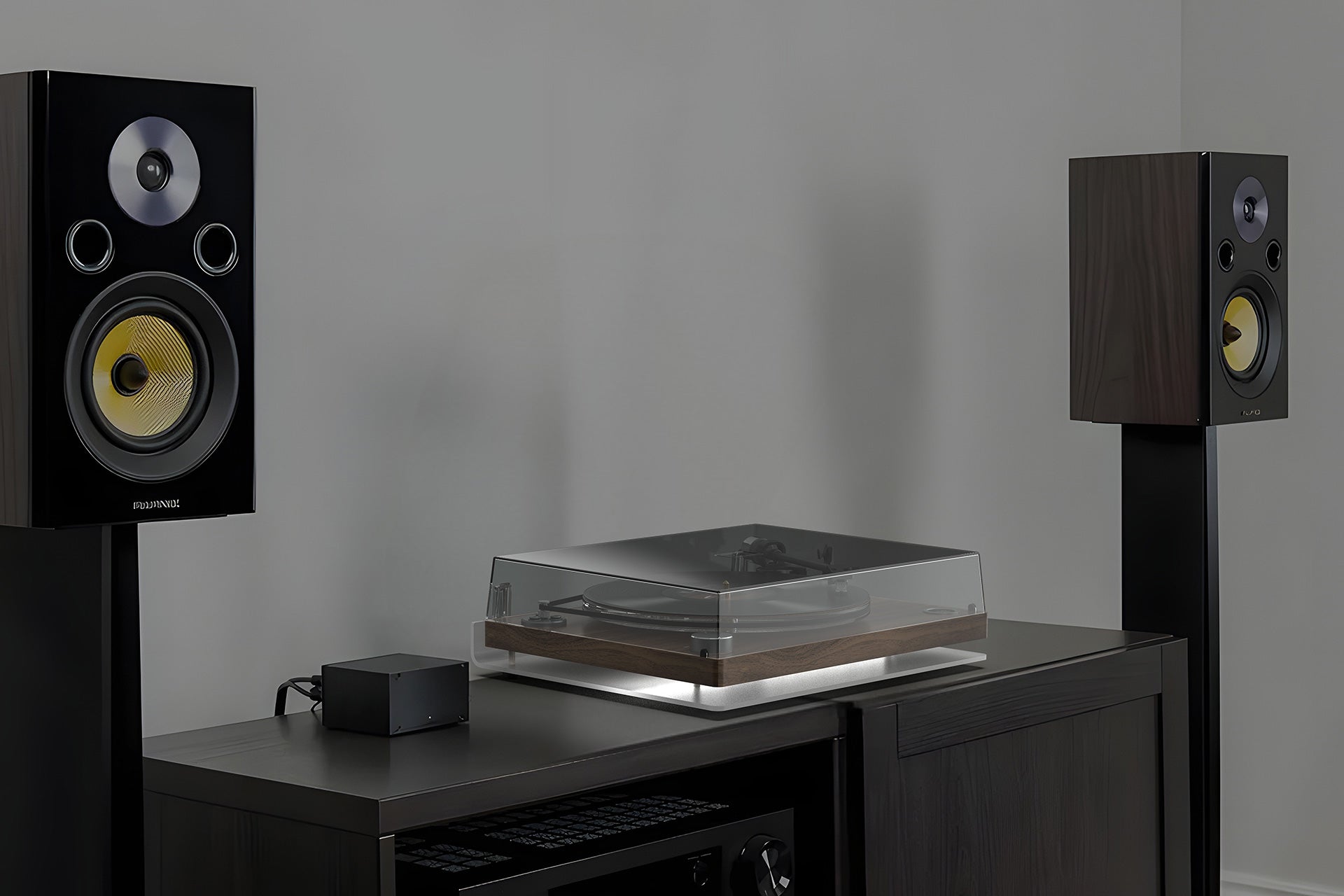
A transparent acrylic turntable such as the AudioKeeper GENESIS-V2 can work with either approach.
With powered speakers, the result can be visually clean and relatively minimal:
GENESIS-V2 + powered speakers
With passive speakers, you can create a more traditional setup:
GENESIS-V2 + amplifier + passive speakers
Because the GENESIS-V2 supports both Bluetooth transmission and RCA connectivity, it can fit into different system designs rather than locking you into one connection method.
That flexibility can be useful as your listening setup evolves.
The Bottom Line
Choose powered speakers if you want:
- simpler setup
- fewer components
- less cabling
- a compact system
- easy everyday listening
Choose passive speakers if you want:
- greater component flexibility
- more upgrade options
- a traditional hi-fi system
- more control over the amplifier and speaker pairing
And remember:
Powered does not mean basic. Passive does not mean automatically better.
Both can form an excellent vinyl system.
The best choice is the one that fits your room, your budget, your equipment, and how much you actually enjoy tinkering with audio.
Because there is one thing every good speaker system should have in common:
It should make you want to play another record.






Leave a comment
All comments are moderated before being published.
This site is protected by hCaptcha and the hCaptcha Privacy Policy and Terms of Service apply.