
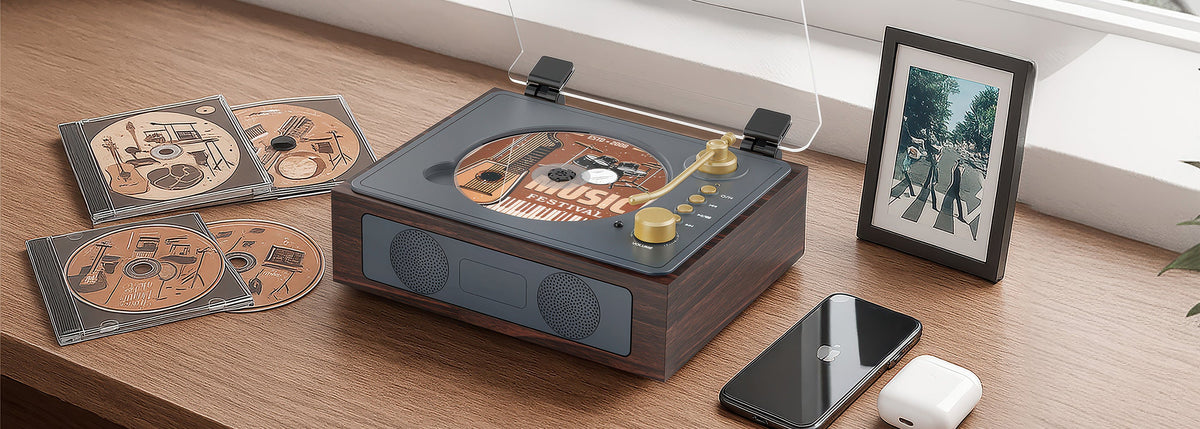
If you're getting back into CDs in 2026, you don't need to recreate the stereo system from your parents' living room.
A modern CD setup can be surprisingly simple: a CD player, a good pair of speakers, and the right connections. From there, you can add other sources or accessories depending on how you actually listen to music.
The goal isn't to build the biggest system possible. It's to create a setup that makes playing a physical album easy and enjoyable.
Start With the CD Player
The CD player is the heart of the system.
There are plenty of options today, from traditional component-style players to compact modern designs. The right choice depends on your space and how much flexibility you want.
Before buying one, consider a few basics:
- Disc compatibility: Make sure it supports the types of CDs you actually use.
- Audio outputs: Check whether it offers RCA, optical, or other connections you'll need.
- Size: A compact player can make more sense for a bedroom, office, or apartment.
- Controls: Physical buttons can make the experience feel more intentional than controlling everything through an app.
- Design: If the player will sit in an open listening area, its appearance matters too.
A CD player doesn't have to look like traditional hi-fi equipment. Modern designs can fit naturally alongside furniture, books, plants, and other home décor.
Choose the Right Speakers
The CD player produces the audio signal, but your speakers turn that signal into something you can actually hear.
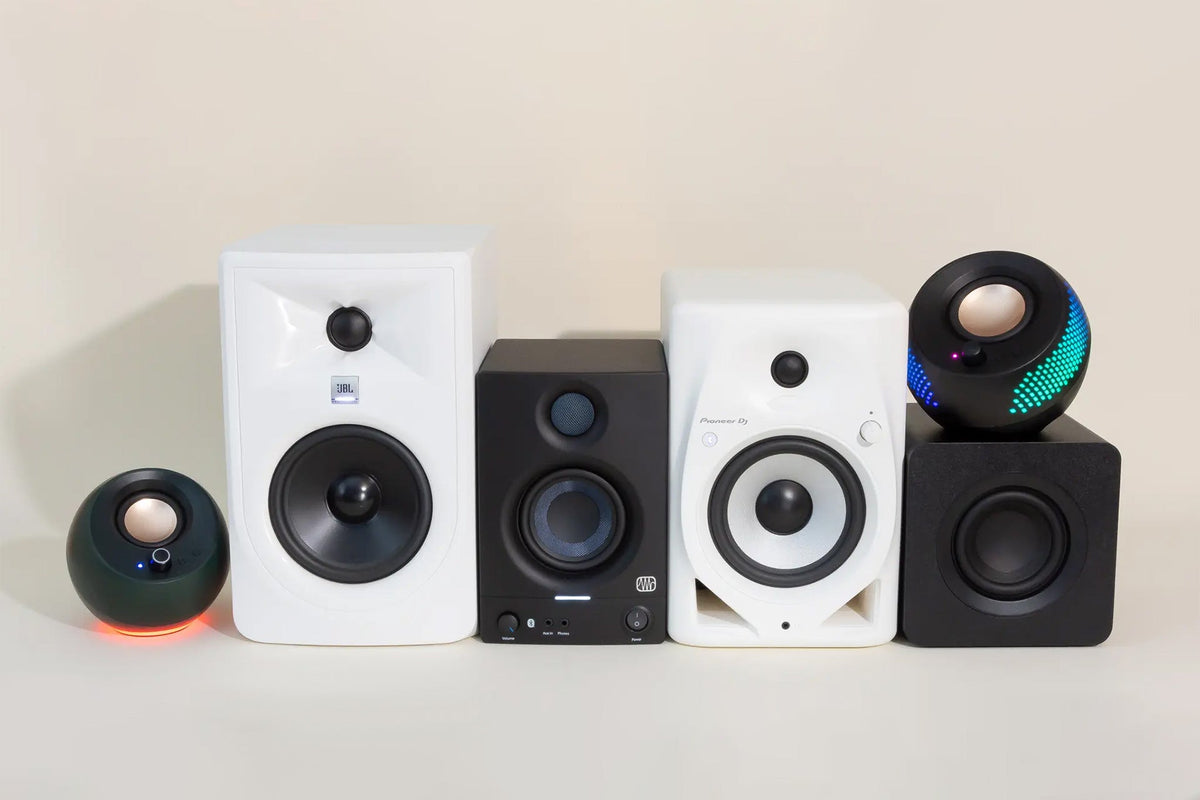
For a simple home setup, powered speakers are often the easiest option.
Powered speakers have amplification built into the speakers themselves, so you don't necessarily need a separate stereo amplifier. Connect the CD player to the appropriate input, place the speakers correctly, and you're ready to listen.
This makes them particularly convenient for smaller systems.
What if You Already Have Bluetooth Speakers?
This is where modern audio gets more flexible.
Some CD players support Bluetooth transmission, allowing compatible wireless speakers or headphones to be used without a traditional wired connection.
However, Bluetooth support varies between products. Always check whether the CD player is designed to transmit audio over Bluetooth, rather than simply receive audio from a phone.
If you're building a system primarily for physical music, wired RCA connections are still a straightforward option when your speakers support them.

Think About Your Room Before Your Equipment
You don't need expensive equipment to create a good listening space.
Room placement can make a surprisingly noticeable difference.
Start by placing your speakers on either side of your listening position rather than putting both in the same area. Avoid pushing them completely into corners if possible, and keep the left and right speakers at roughly similar distances from where you normally sit.
For a small room, compact bookshelf-style or desktop speakers can work well.
The important thing is to build the system around the room you actually have.
A bedroom doesn't need the same equipment as a large open-plan living room.
Add a Turntable If You Also Listen to Vinyl
If you're interested in physical music more broadly, there's no reason your CD setup has to exist separately from your vinyl setup.
A modern home audio system can accommodate both.
For example:
CD player → speakers
and
Turntable → speakers
Depending on the equipment, you may be able to connect both sources to the same speaker system and switch between them.
That's useful if you collect both CDs and vinyl but don't want two completely separate listening stations.
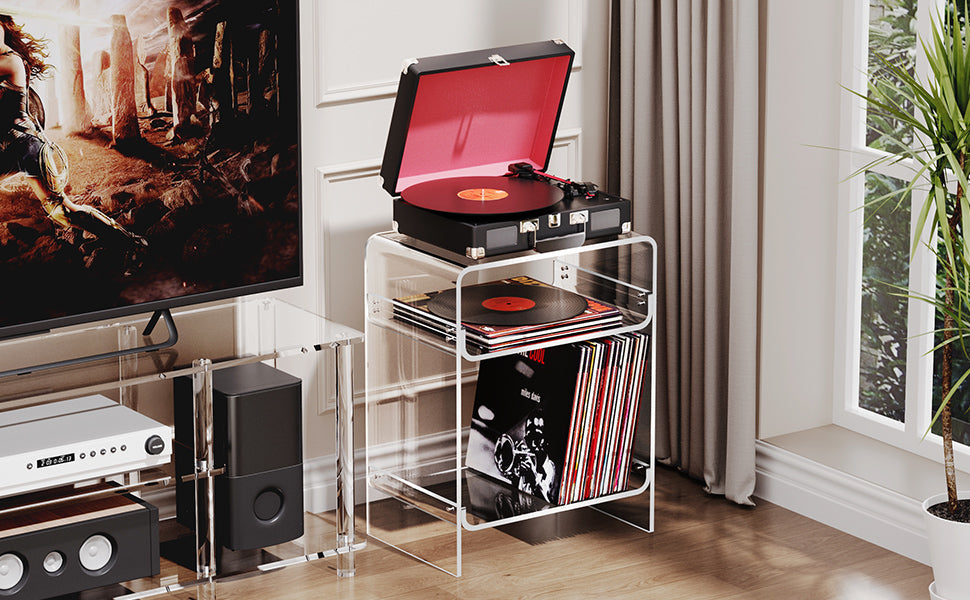
A turntable such as the AudioKeeper GENESIS-V2 can also become part of the visual setup. Its transparent acrylic construction gives the turntable a very different presence from traditional wooden models, particularly when paired with a modern CD player and clean-looking speakers.
Don't Forget the Display
Physical music has one advantage that streaming can't really replicate: you can see your collection.
Instead of putting every CD and record away, consider keeping the album you're currently listening to visible.
A small record holder can display the cover of the album currently playing, while the rest of your collection can remain organized nearby.
For vinyl, an acrylic record stand can be especially useful in a modern interior because it keeps the album visible without introducing another heavy visual element.
The same principle can work around a CD player. A small selection of favorite albums can make the listening area feel personal rather than purely functional.
Keep the Setup Simple
It's easy to get carried away once you start looking at audio equipment.
You don't necessarily need:
- A large amplifier
- Multiple speaker pairs
- Complicated cables
- Several audio sources
- A huge media cabinet
Start with the format you actually use.
If you're rediscovering your CD collection, a CD player + powered speakers may be all you need.
If you also collect vinyl, add a turntable.
If you stream music regularly, choose equipment that accommodates that as well.
The best system is usually the one you'll actually use.
A Simple Modern Setup
For someone starting from scratch, here's an easy way to think about it:
Small room
CD player → compact powered speakers
Vinyl + CD
Turntable + CD player → powered speakers
Physical + wireless
Turntable + CD player → speakers
Phone → Bluetooth
Display-focused listening corner
CD player + speakers + acrylic record holder + selected albums
None of these setups needs to be complicated.
What matters is matching the equipment to your listening habits, available space, and the experience you want from your music collection.

Build Around How You Listen
The return of physical music doesn't mean everyone needs to recreate a vintage hi-fi system.
Today's listening spaces can be much more flexible.
A CD player can sit beside a turntable. Bluetooth can coexist with RCA. A pair of compact speakers can replace a large traditional stereo stack. And an acrylic record stand can turn the album you're playing into part of the room's design.
Start with the music, then build the system around it.
That's what makes a modern CD setup different: it doesn't have to look backward to enjoy physical music again.






Leave a comment
All comments are moderated before being published.
This site is protected by hCaptcha and the hCaptcha Privacy Policy and Terms of Service apply.