
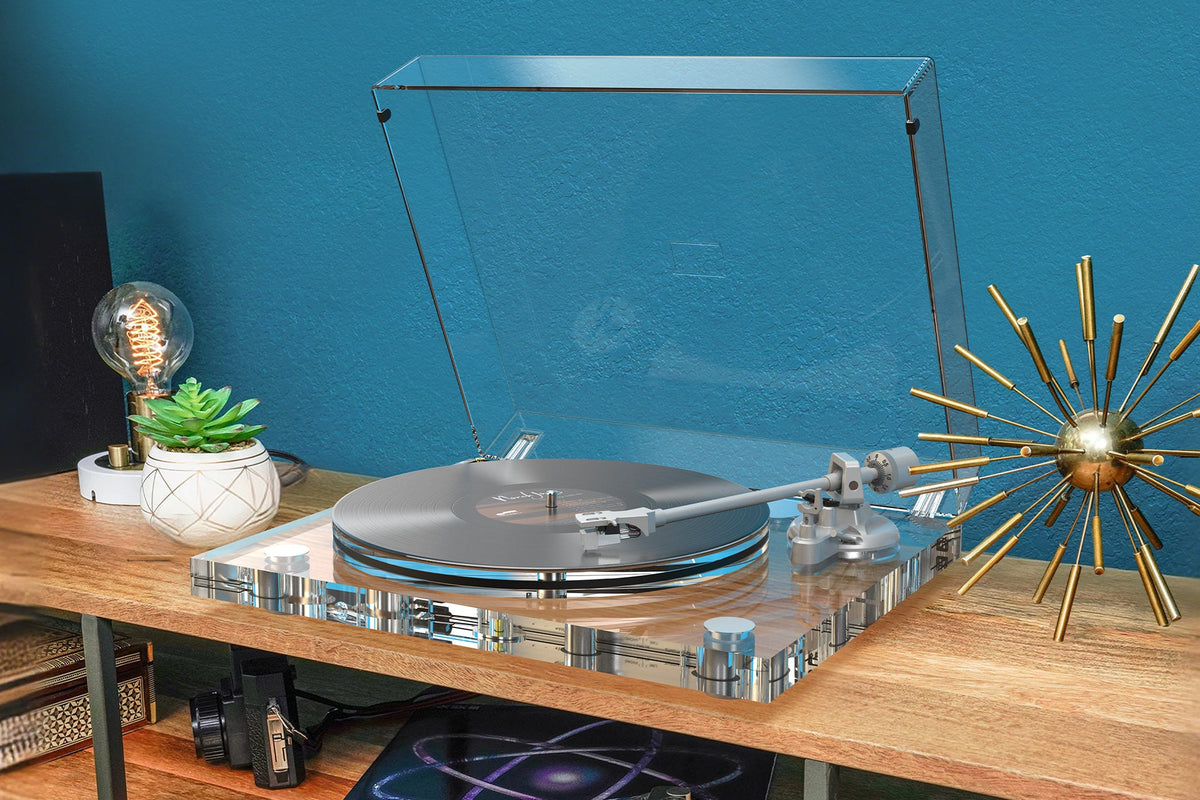
A Bluetooth turntable sounds like a contradiction.
Vinyl is physical, mechanical, and deliberately slow. Bluetooth is wireless, convenient, and very much a product of the digital age.
So is putting Bluetooth on a record player actually a good idea?
For many listeners, yes. But it depends on what you want from your vinyl setup.
A Bluetooth turntable can make vinyl dramatically easier to integrate into a modern home, especially when you already use wireless speakers or headphones. The trade-off is that a wireless connection adds another stage between the turntable and your ears, and some listeners will still prefer a completely wired signal path.
The important thing is not whether Bluetooth is "good" or "bad."
It is whether the convenience is worth the trade-offs for your particular system.
What Does a Bluetooth Turntable Actually Do?
A Bluetooth turntable can transmit the audio signal from a record wirelessly to a compatible Bluetooth device.
The basic chain is:
Vinyl → stylus → cartridge → turntable → Bluetooth transmitter → speaker or headphones
That last step is what separates a Bluetooth transmitter from a Bluetooth receiver.
A turntable with Bluetooth transmission can send audio outward. That makes it possible to use compatible Bluetooth speakers, headphones, or amplifiers without a traditional RCA connection.
Current products show that this has become a serious category rather than a novelty. Sony's 2026 PS-LX5BT, for example, supports Bluetooth transmission with SBC, aptX, and aptX Adaptive, while Pro-Ject's E1.2 BT uses a Bluetooth 5.4 transmitter with aptX HD support.
The Biggest Reason to Buy One: Convenience
Let's be honest.
Bluetooth is convenient.
You don't have to run an RCA cable from one side of the room to the other. Your headphones don't need a cable running back to an amplifier. A compatible speaker can sit where it makes the most sense in the room rather than where the cable allows it to sit.
That can make a much bigger difference than it sounds.
Consider a small apartment.
You have a turntable on a console.
Your preferred speaker is on the other side of the room.
With a traditional wired setup, the cable needs to cross that distance or the equipment needs to move.
With Bluetooth, the physical placement can be much more flexible.
For many people, that is the feature they are actually paying for.

Does Bluetooth Sound Worse?
This is the question that usually starts the argument.
There is no one-size-fits-all answer.
Bluetooth audio can involve compression and depends on the codec and implementation used by both the transmitting and receiving devices. Different Bluetooth solutions can therefore produce different results.
For example, Sony's current PS-LX5BT supports SBC, aptX, and aptX Adaptive, while Pro-Ject's E1.2 BT supports aptX HD.
So simply saying "Bluetooth sounds bad" is outdated.
But saying "Bluetooth is exactly the same as a wired connection" is also too broad.
A wired connection keeps the audio signal in the analog chain after the turntable's output stage. A Bluetooth system converts the signal for wireless transmission and then reconstructs it at the receiving device.
Whether you can hear a meaningful difference depends on the equipment and the listener.
For casual listening, the difference may matter very little.
For someone building a highly optimized hi-fi system, it may matter quite a lot.
Bluetooth Turntables Are About the Whole System
This is an important distinction.
A turntable is not a standalone sound-quality guarantee.
Its performance is influenced by the:
- cartridge
- stylus
- tonearm
- platter
- bearing
- motor
- isolation
- phono stage
- amplifier or powered speakers
- listening environment
Bluetooth is only one part of that chain.
A beautifully engineered turntable can offer Bluetooth without becoming a "cheap Bluetooth gadget."
Likewise, adding Bluetooth to a poorly designed turntable will not magically make it good.
So when evaluating a Bluetooth record player, look at the entire product rather than treating wireless connectivity as the headline specification.

When Is a Bluetooth Turntable Worth It?
1. You Already Own Bluetooth Speakers
This is probably the easiest case.
If you already have a good Bluetooth speaker, a compatible Bluetooth turntable can add vinyl without requiring you to buy an amplifier and a completely new speaker system.
You are using equipment you already own.
That can be both convenient and economical.
2. You Want a Cleaner Room
Some people simply do not want cables everywhere.
A turntable is already visually prominent. Adding a long RCA cable and speaker wires can make a simple setup feel surprisingly complicated.
Wireless connectivity lets you keep the physical experience of vinyl without making the room look like a wiring project.
3. You Listen With Headphones
Bluetooth can be particularly useful for private listening.
You can sit comfortably away from the turntable without being physically connected to it by a headphone cable.
For apartments, shared spaces, and late-night listening, that can be a genuine advantage.
4. You Are New to Vinyl
Beginners are often better served by a system that they will actually use.
A complicated setup with multiple components can be rewarding, but it can also become intimidating.
A Bluetooth turntable can lower the barrier to entry.
You can start with a simple wireless setup and expand later.
5. You Want Both Wireless and Wired Options
This may be the smartest reason of all.
A turntable that supports both Bluetooth and RCA does not force you to choose one philosophy forever.
You can use Bluetooth today and build a more traditional wired system later.
Current Bluetooth models increasingly offer this kind of flexibility. Sony's PS-LX5BT, for example, supports both Bluetooth transmission and wired connectivity, including a built-in phono preamp and switchable Phono/Line output.
When Is a Bluetooth Turntable Probably Not Worth It?
There are also situations where Bluetooth may not be the best choice.
You Are Building a Dedicated Hi-Fi System
If you already own a high-quality amplifier, phono stage, and passive speakers, Bluetooth may add little value.
You have already invested in a wired audio chain.
In that case, RCA may simply be the more appropriate connection.
You Want Maximum Control Over the Signal Path
Some listeners enjoy optimizing every stage of the system.
They want to choose the cartridge, phono stage, interconnects, amplifier, and speakers independently.
Wireless transmission introduces another layer of processing into that chain.
For this kind of listener, wired playback can make more sense.
You Never Use Wireless Audio
This one is obvious but easy to overlook.
If all of your speakers are wired, your amplifier is already set up, and you have no interest in wireless headphones, paying extra for Bluetooth may not provide much practical value.
A feature is only useful when you use it.
Does Bluetooth Make a Turntable Less "Authentic"?
Not really.
This argument comes up because vinyl is often associated with an entirely analog signal chain.
But there is no requirement that every component after the record remain analog for the physical experience of playing vinyl to be meaningful.
The record is still physically there.
The stylus is still tracking the groove.
You are still choosing an album and putting it on the platter.
Bluetooth changes the connection between the turntable and the listening device.
It does not remove the record itself.
For some listeners, keeping the entire signal chain wired is part of what they enjoy.
For others, the convenience of wireless listening is worth the compromise.
Neither preference is inherently more "real."
Does a Bluetooth Turntable Need an Amplifier?
Not always.
It depends on where the audio is going.
With a Bluetooth speaker or compatible Bluetooth headphones:
Turntable → Bluetooth → receiving device
You generally do not need a separate amplifier for that wireless connection.
With passive speakers, however, you still need an appropriate amplifier.
With powered speakers, the amplifier is built into the speakers.
This is why understanding your complete setup is more useful than simply asking whether a turntable has Bluetooth.
What Should You Look for in a Bluetooth Turntable?
Don't stop at the word "Bluetooth."
Check the Bluetooth direction
Make sure it supports transmission/output if you want to connect wireless speakers or headphones.
Check the codecs
Different models support different Bluetooth codecs. Better-supported codecs can matter if the receiving equipment supports them too.
Check wired outputs
RCA gives you another option if you later want to build a wired system.
Check the phono stage
A built-in phono preamp can simplify connecting the turntable to powered speakers or line-level equipment.
Look at the core turntable components
Pay attention to the cartridge, tonearm, platter, drive system, speed control, and isolation.
Bluetooth should be one consideration—not the entire buying decision.
Think about future upgrades
A turntable with both wireless and wired connectivity can give you more flexibility as your system evolves.
Bluetooth Turntable vs. Traditional Turntable
A quick comparison can make the choice easier:
| Priority | Bluetooth Turntable | Traditional Wired Turntable |
|---|---|---|
| Simple setup | Excellent | Depends on system |
| Wireless speakers | Excellent | Usually requires an adapter or additional equipment |
| Bluetooth headphones | Convenient | Usually requires additional equipment |
| Cable-free room | Better | More cables |
| Traditional hi-fi integration | Good if RCA is included | Excellent |
| Signal-chain flexibility | Depends on model | Usually greater |
| Beginner-friendly | Often | Can require more planning |
| Upgrade flexibility | Good with dual connectivity | Often excellent |
The important takeaway is that Bluetooth and traditional turntables are not necessarily opposite categories.
A modern turntable can offer both.

A Modern Example: AudioKeeper GENESIS-V2
The AudioKeeper GENESIS-V2 takes this hybrid approach.
It combines a transparent acrylic design with Bluetooth transmission and RCA connectivity, allowing it to work in both modern wireless systems and more traditional wired setups.
That matters because the listener does not have to decide exactly what their audio system will look like five years from now.
You can begin with a compatible Bluetooth speaker.
Later, you can move to powered bookshelf speakers.
Eventually, you might want a more traditional amplifier and passive-speaker system.
The same turntable can remain part of that progression.
And because the GENESIS-V2 is also designed as a visually distinctive acrylic turntable, it can work as part of the room rather than looking like equipment that needs to be hidden away.
So, Are Bluetooth Turntables Worth It?
For the right listener, absolutely.
A Bluetooth turntable makes particular sense when convenience, flexible placement, private listening, and simple setup are important.
It is less compelling when you already have a carefully optimized wired hi-fi system and have little use for wireless connectivity.
The mistake is treating Bluetooth as either a revolutionary upgrade or a terrible compromise.
It is neither.
It is simply another connection method—and a very useful one for modern vinyl systems.
The best Bluetooth turntable is therefore not the one with the longest list of wireless specifications.
It is the one that fits the rest of your system.
If Bluetooth makes you more likely to play your records, it is doing its job.







Leave a comment
All comments are moderated before being published.
This site is protected by hCaptcha and the hCaptcha Privacy Policy and Terms of Service apply.