

A turntable can play a record beautifully.
It just can't play it for you by itself.
Unless you're using an all-in-one record player with built-in speakers, you need to think about what comes next: the speakers.
And this is where many first-time vinyl buyers get stuck.
Do you need powered speakers or passive speakers? Can a turntable connect directly to speakers? Do you need an amplifier? What about Bluetooth? And does an expensive turntable need expensive speakers?
The good news is that building a vinyl listening system doesn't have to be complicated.
The key is understanding how the pieces fit together.
First: A Turntable Is Not a Complete Audio System
A standalone turntable produces a signal. Your speakers are responsible for turning that signal into the room-filling sound you actually hear.
A typical system can look like:
Turntable → powered speakers
or:
Turntable → amplifier → passive speakers
Or, with a compatible wireless setup:
Turntable → Bluetooth → Bluetooth speaker
The right arrangement depends on the equipment you choose.
Before buying anything, know where the amplification happens.
That one detail eliminates a lot of confusion.
Powered vs. Passive Speakers
This is probably the most important decision.
Powered Speakers
Powered speakers have amplification built into the speakers themselves.
That means you don't need a separate stereo amplifier.
A simple system might be:
Turntable → powered speakers
If your turntable also has a built-in phono preamp, the setup can be particularly straightforward.
Powered speakers are often a good choice for:
- apartments
- bedrooms
- desks
- smaller living rooms
- first-time vinyl systems
- listeners who want fewer components
They give you a complete left-and-right speaker system without requiring another box in between.
Passive Speakers
Passive speakers do not contain their own power amplifier.
They need an amplifier or receiver.
The system becomes:
Turntable → amplifier → passive speakers
This adds another component, but it also gives you more flexibility.
You can choose the amplifier and speakers separately and upgrade them independently.
For listeners who enjoy building a traditional stereo system, that flexibility can be a major advantage.

Do You Need an Amplifier for a Turntable?
Not always.
If you're using powered speakers, the amplifier is already built into the speakers.
If you're using passive speakers, you'll need a separate amplifier.
If you're using a compatible Bluetooth speaker, the speaker's own electronics handle the amplification after receiving the wireless signal.
So the better question is:
Where is the amplifier in my system?
Once you answer that, the rest becomes much easier.

Don't Forget the Phono
There is another piece of the puzzle: the phono preamp, also called a phono stage.
A turntable's cartridge produces a low-level phono signal that needs appropriate amplification and equalization before being sent to a normal line-level input.
Depending on the equipment, the phono stage may be:
- built into the turntable
- built into the amplifier
- built into an external phono preamp
Some modern turntables use a switchable built-in phono stage, allowing the same turntable to work with different kinds of audio equipment.
Always check the specifications before connecting your system.
Otherwise, you can end up with a perfectly good turntable and speakers—and very little sound.

What About Bluetooth Speakers?
Bluetooth can make a vinyl system remarkably simple.
With a turntable that supports Bluetooth transmission:
Turntable → Bluetooth → Bluetooth speaker
This can be useful when:
- you already own a good Bluetooth speaker
- you want minimal cabling
- your room is small
- you move your speaker around
- you're creating a flexible modern setup
The key is that the turntable needs to transmit Bluetooth audio.
A turntable that only receives Bluetooth from a phone cannot necessarily send vinyl audio to a Bluetooth speaker.
That distinction is easy to miss.
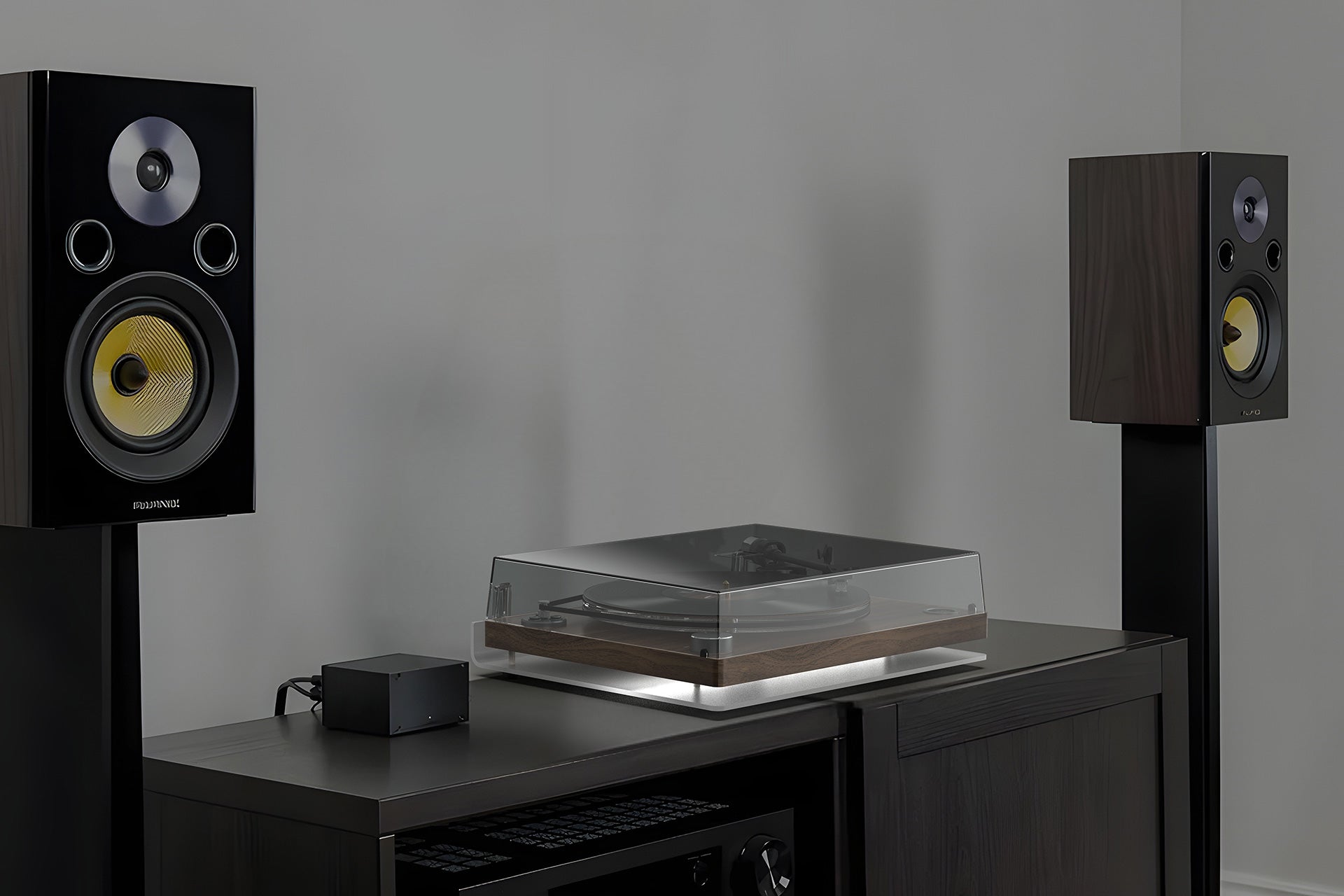
What About a Pair of Powered Bookshelf Speakers?
For many listeners, this is the sweet spot.
You get a true left/right stereo setup without needing a separate amplifier.
The basic arrangement is:
Turntable → powered bookshelf speakers
It can offer a more traditional stereo experience while keeping the system relatively compact.
This is often a good choice when sound and simplicity both matter.
And unlike a single Bluetooth speaker, a pair of speakers can create a proper stereo image when positioned appropriately in the room.
How Far Apart Should Your Speakers Be?
There is no universal measurement that works for every room, but speaker placement matters.
Ideally, the two speakers should form a roughly balanced listening triangle with your main listening position.
In simple terms:
Left speaker → listening position ← right speaker
Try to keep the speakers at a similar distance from where you usually sit.
Avoid pushing one speaker into a corner while leaving the other exposed in open space if you can help it.
And whenever possible, don't place the speakers so close to the turntable that strong vibration is transferred directly into it.
Good equipment still benefits from good placement.
Should Your Turntable Cost More Than Your Speakers?
Not necessarily.
There is no useful rule saying your turntable should always cost twice as much as your speakers—or the other way around.
The system matters more than the price ratio.
A highly capable turntable paired with inadequate speakers may leave you underwhelmed.
An excellent speaker system paired with a poorly configured turntable has its own problems.
Instead, think about balance.
The turntable should provide a solid source.
The speakers should be capable of revealing what that source is delivering.
And the room should allow both to work properly.
How to Match a Turntable With Your Room
Your room is part of the system whether you like it or not.
A large speaker may be unnecessary in a small bedroom.
A tiny Bluetooth speaker may struggle to fill a large open-plan living space.
For a smaller room, consider:
Turntable + compact powered speakers
For a larger listening space:
Turntable + larger powered speakers
or:
Turntable + amplifier + passive speakers
And for a flexible minimalist setup:
Bluetooth turntable + wireless speaker
The best choice isn't necessarily the most powerful one.
It is the one that suits the space.

What About an Acrylic Turntable?
This is where design enters the equation.
A transparent or acrylic turntable can work particularly well in a modern listening space because the turntable itself becomes part of the room's visual character.
But the speakers still need to fit that aesthetic.
A transparent turntable paired with enormous conventional speakers may create a very different visual effect from a clean pair of compact bookshelf speakers.
There is no need for everything to match perfectly.
Instead, look for some common visual language—similar proportions, materials, finishes, or simply a sense that the pieces belong together.
A Modern Example: AudioKeeper GENESIS-V2 + Speakers
The AudioKeeper GENESIS-V2 is designed to give listeners more than one way to build their system.
With RCA connectivity, it can be paired with compatible powered speakers or integrated into a more traditional amplifier-and-speaker setup.
Its Bluetooth transmission also allows it to connect with compatible wireless speakers for a cleaner setup.
That means you can start small.
For example:
GENESIS-V2 + powered bookshelf speakers
Then, if you later want to experiment with a more traditional system, the turntable can remain the source while the rest of your components change.
For listeners who care about aesthetics as well as sound, its transparent acrylic construction also gives the entire setup a more contemporary visual character.

Three Good Turntable + Speaker Setups
The simplest
Bluetooth turntable + Bluetooth speaker
Best for convenience and minimal equipment.
The compact stereo
Turntable + powered bookshelf speakers
Best for listeners who want stereo sound without a separate amplifier.
The traditional system
Turntable + phono stage/amplifier + passive speakers
Best for listeners who want maximum component flexibility and a more traditional hi-fi setup.
None is universally superior.
They simply suit different listeners.
Common Pairing Mistakes
Buying passive speakers without an amplifier
They need one.
Assuming Bluetooth means every device can connect
Check whether the turntable transmits Bluetooth and whether the speaker can receive it.
Forgetting the phono stage
Make sure the turntable signal is being sent to the correct type of input.
Choosing speakers based only on appearance
Speakers are too important to buy as décor alone.
Ignoring the room
Even excellent equipment can sound disappointing in a poorly arranged space.
The Right System Is the One That Makes Listening Easy
There is a tendency to make audio systems seem more complicated than they really are.
But the basic principle is simple.
The turntable is the source.
The phono stage handles the turntable's signal when required.
The amplifier provides power when passive speakers are used.
The speakers turn the signal into sound.
Bluetooth can remove some of the cables between those stages.
Once you understand that chain, choosing equipment becomes much less intimidating.
And there is no requirement to build the biggest system possible.
A compact turntable and two good powered speakers can be enough.
A Bluetooth setup can be enough.
A carefully assembled hi-fi system can be enough.
The best system is the one that fits your room, your budget, and the way you actually listen to music.
Because the goal was never to own the most equipment.
The goal is to put on a record and enjoy it.







Leave a comment
All comments are moderated before being published.
This site is protected by hCaptcha and the hCaptcha Privacy Policy and Terms of Service apply.