
Gen Z has grown up with something previous generations could barely imagine: almost every song, album, and artist is only a few taps away.
There is no need to wait for a new release at the record store. No need to rewind a cassette. No need to save up for an album before hearing it.
Streaming has made music incredibly accessible.
So why are young people buying vinyl records?
It is an interesting contradiction. The generation most comfortable with digital music is also helping give physical music a new lease on life.
And nostalgia doesn't fully explain it.
For many younger listeners, vinyl is not about returning to a world they remember. It is about discovering something they never experienced firsthand.
Gen Z Didn't Grow Up With Vinyl. That's the Point.
For older vinyl listeners, buying a record can carry a sense of memory.
Maybe it reminds them of a childhood living room, a parent's record collection, or the first album they bought with their own money.
Gen Z has a different relationship with the format.
For many younger listeners, vinyl is not a recovered habit.
It is a new one.
That makes the current vinyl revival more interesting than a simple nostalgia cycle.
A young person buying a record today may have discovered the artist on Spotify, watched their videos on TikTok or Instagram, followed them online, and then decided they wanted something physical to keep.
The journey starts digitally.
The purchase ends physically.
Streaming Made Music Easy. Vinyl Makes It Feel Tangible.
There is very little friction between wanting to hear a song and actually hearing it.
Search.
Tap.
Listen.
That is one of the great achievements of streaming.
But convenience can also make music feel almost invisible.
You can have thousands of albums in a digital library without ever seeing them as objects.
A vinyl record does the opposite.
You can hold the album.
You can see the artwork.
You can read the liner notes.
You can put it on a shelf.
You can pull it out, place it on the platter, and physically start the album.
For some listeners, that physical interaction is part of what they are buying.
The music comes with an object.
And the object can have meaning of its own.

Vinyl Is Not Necessarily About Sound Quality
This is one of the easiest assumptions to make about a new generation of vinyl buyers:
They must be buying records because they believe analog sounds better.
Some certainly are.
But it would be a mistake to assume that is the main reason for everyone.
A record's sound depends on many factors, including the mastering, pressing quality, playback equipment, cartridge and stylus, and the condition of the record itself.
And plenty of younger listeners are perfectly comfortable using both streaming and vinyl.
They may stream an album while commuting and play the same album on vinyl at home.
That doesn't represent a contradiction.
It represents two different ways of interacting with the same music.
The Album Becomes an Object
One of the strongest reasons physical music continues to appeal to younger listeners is that an album can become more than an audio file.
The artwork is bigger.
The packaging is tactile.
Special pressings can have different colors, sleeves, inserts, or other collectible details.
Even the process of choosing which record to play can become part of the experience.
This matters especially for artists whose audiences feel emotionally connected to them.
The purchase can feel like a way of saying:
I don't just listen to this artist. I want something that represents my connection to them.
That is one reason physical music has become closely associated with the idea of the music "superfan." Luminate research cited by Music Business Worldwide found that physical music buyers are significantly more likely to fall into its superfan category, while younger listeners also tend to be more engaged with music across multiple channels.

A Record Collection Can Say Something About You
A streaming library is personal, but it is mostly invisible.
A record collection is different.
Put twenty favorite albums on a shelf and someone visiting your home can immediately see your musical personality.
They may recognize an artist.
They may ask about an album.
They may pick one up and say, "I love this record."
That makes vinyl surprisingly social.
The collection becomes part of the room.
It can also become part of someone's online identity.
Social platforms have made it easier than ever to share collections, listening setups, record finds, unboxings, and shelf displays.
Research into music engagement on Instagram reinforces this broader connection between social participation and physical music buying: Luminate data cited by Music Business Worldwide found that highly engaged music users on Instagram were more likely than the broader user base to buy vinyl and to spend more on music overall.
The physical record is therefore doing two jobs.
It is something you listen to.
It is also something you can show.
The Vinyl Ritual Is Part of the Appeal
There is a reason people sometimes describe vinyl listening as a ritual.
You have to do things.
Choose the record.
Take it out.
Place it on the platter.
Check the record.
Lower the tonearm.
Listen.
Then, eventually, turn it over.
Streaming removes almost all of those steps.
That is a feature when you are trying to make music as effortless as possible.
But effort is not always the enemy.
Sometimes a little friction creates attention.
You are less likely to casually switch between ten albums when the next one requires you to physically get up.
That can encourage something increasingly unusual in modern listening:
staying with one album.
Why Whole Albums Still Matter
Streaming was built around individual songs and endless discovery.
Vinyl naturally pushes listeners back toward the album.
That does not mean every Gen Z listener suddenly prefers listening to albums from beginning to end.
But the format makes the album feel important again.
The cover, track order, side A, side B, artwork, and packaging all contribute to a single object.
That can be especially interesting for younger artists who are using vinyl not simply to reproduce an old format, but to extend the creative world around a release.
The physical edition becomes part of the album's identity.

Gen Z Is Not Rejecting Streaming
This distinction is important.
The growth of vinyl should not be interpreted as young listeners abandoning streaming.
They aren't.
Streaming remains the dominant way most people access music. RIAA's 2025 U.S. data, for example, shows paid subscriptions generating the largest share of recorded-music revenue, while vinyl continued its long run of growth.
That tells us something useful:
The future of music does not have to be vinyl versus streaming.
It can be vinyl and streaming.
Streaming is ideal for:
- discovering new artists
- building playlists
- listening anywhere
- exploring unfamiliar genres
- accessing enormous catalogs
Vinyl is useful for:
- collecting favorite albums
- owning physical music
- displaying artwork
- intentional album listening
- supporting artists through physical purchases
- creating a more tactile listening experience
One format does not have to replace the other.
The First Turntable Is Part of the Experience
Buying your first few records is one thing.
Actually playing them is another.
That's where the turntable becomes important.
A new listener may be less interested in building a complicated hi-fi rack than an experienced audiophile would be. They may want something that looks good, is relatively straightforward to set up, works with modern speakers, and feels appropriate in a contemporary room.
This is one reason modern turntables can look very different from the large stereo systems associated with earlier generations.
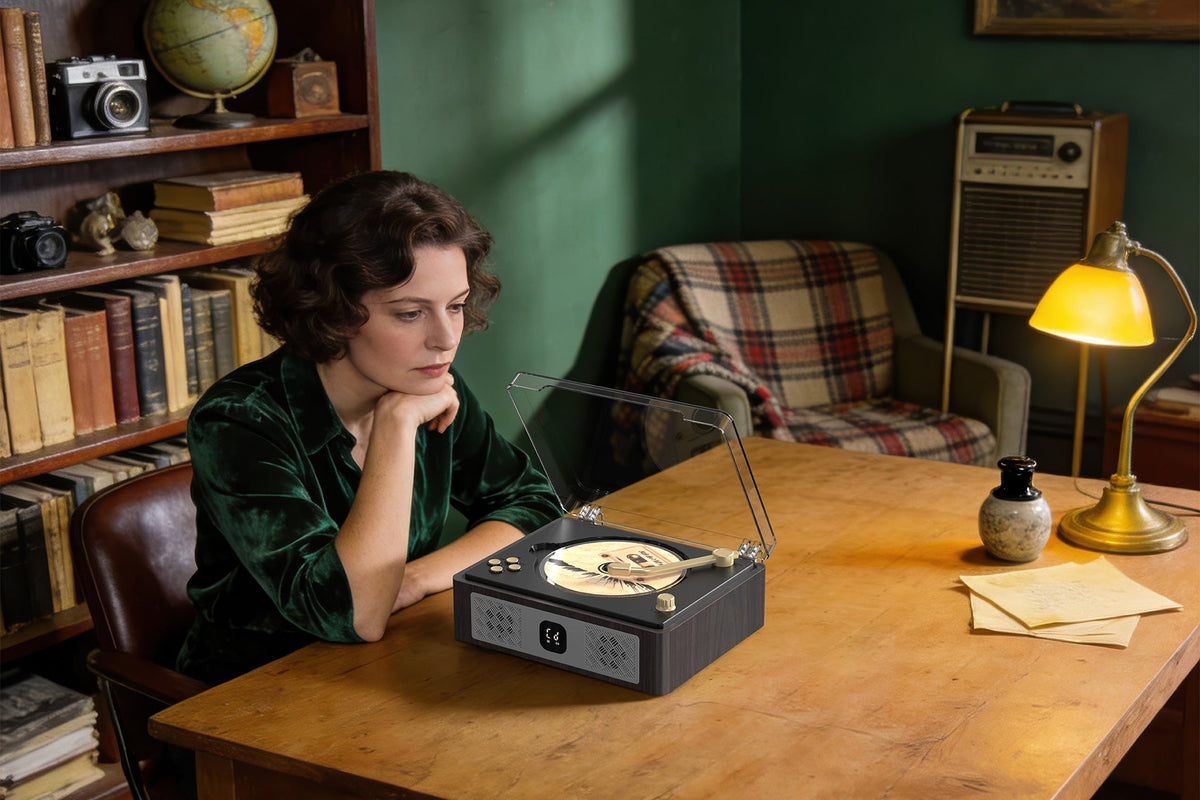
Bluetooth connectivity can make setup easier.
Compact powered speakers can reduce the number of components.
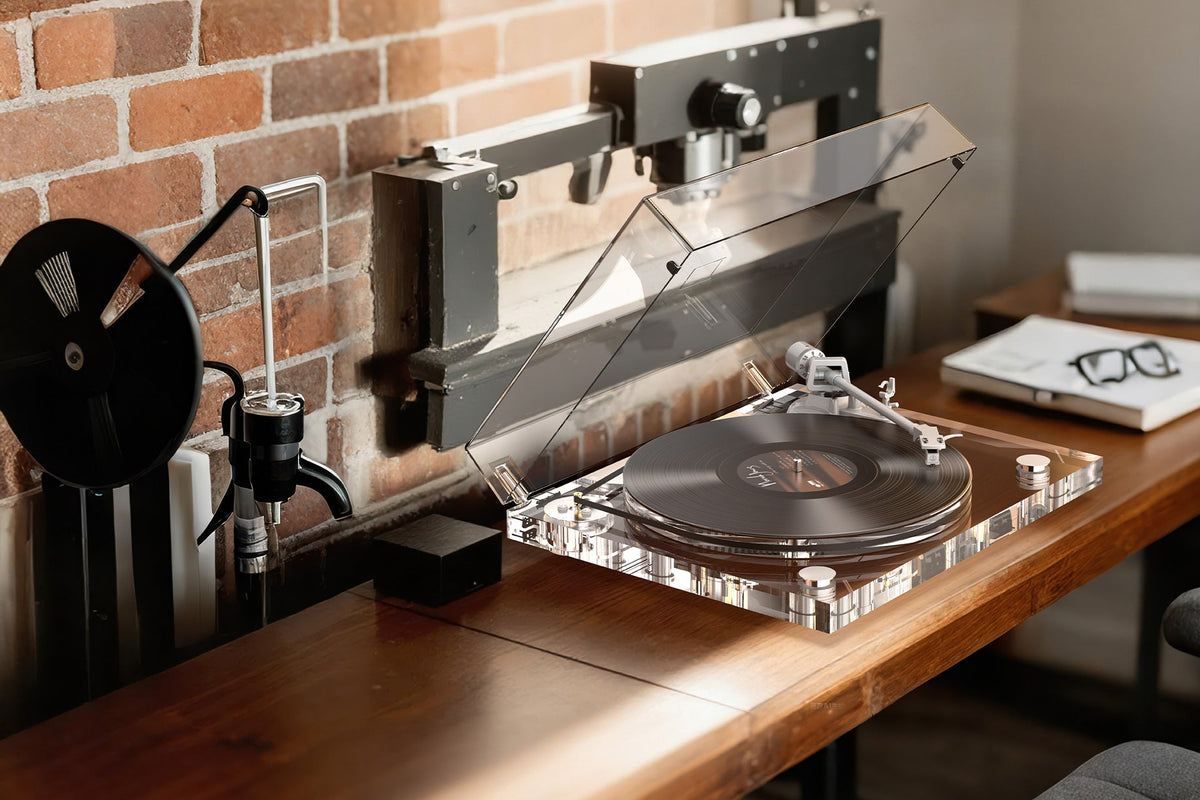
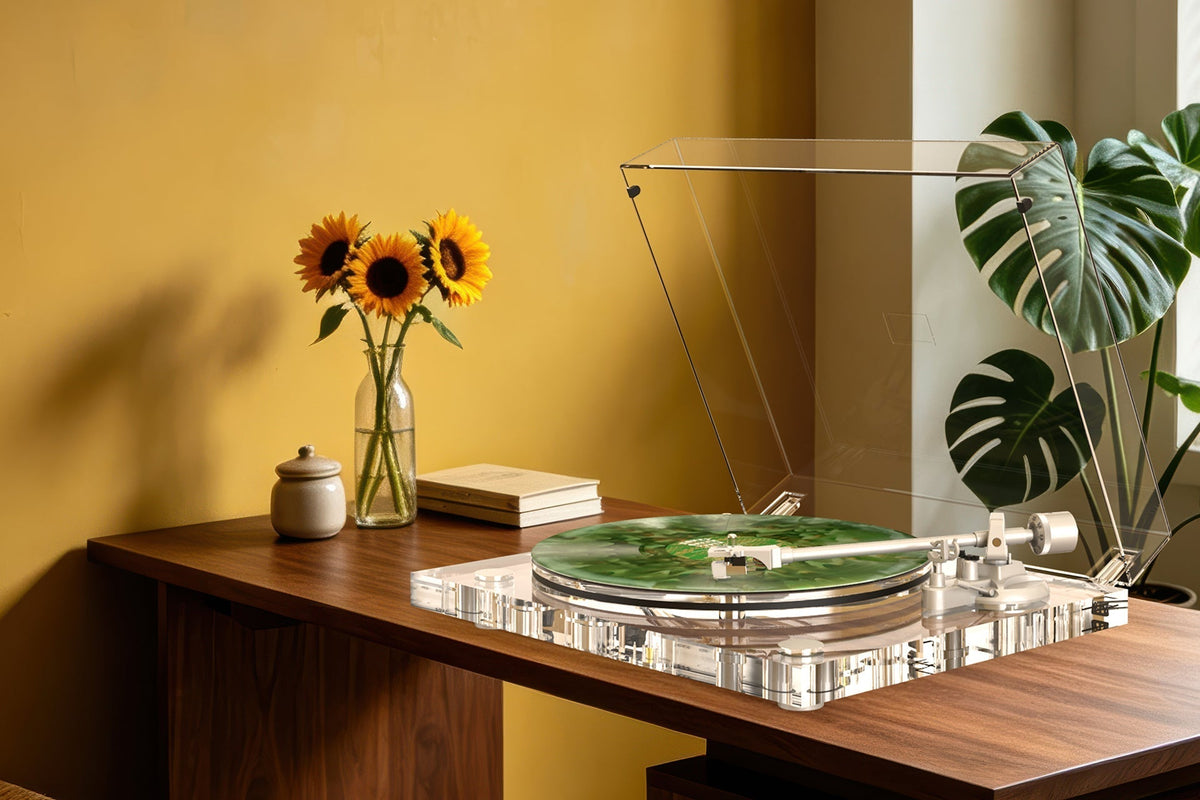
A clear or acrylic turntable can turn the player itself into part of the room's design.
The format may be old.
The hardware doesn't have to feel old.
Why Acrylic Turntables Make Sense for a New Vinyl Listener
Acrylic is especially interesting in this context because it changes the visual role of the turntable.
A traditional record player can look like a piece of vintage furniture.
A transparent record player can feel more like contemporary design.
The record remains the visual center while the turntable's structure becomes partially transparent around it.
For someone discovering vinyl through modern music, contemporary interiors, and social media, that can make the product feel less like a piece of inherited technology and more like something designed for their generation.
The AudioKeeper GENESIS-V2 follows that design direction with a transparent acrylic construction, while also offering modern Bluetooth and RCA connectivity.
That combination matters.
A new listener does not necessarily have to choose between:
the physical character of vinyl
and
the convenience of modern audio equipment.
A contemporary turntable can offer both.

Vinyl Is Becoming a Lifestyle Choice
This may be the biggest shift of all.
Vinyl used to be primarily discussed as an audio format.
Today, it can also be:
- a collectible
- a display object
- a gift
- a hobby
- a social interest
- part of a home's décor
- a way to support an artist
- a reason to visit a record store
That broader role helps explain why the audience for physical music can continue to evolve.
In 2025, U.S. vinyl revenue reached $1 billion, up 9.3%, marking the format's 19th consecutive year of growth, according to the RIAA.
The interesting part isn't simply that vinyl is still selling.
It is that the people buying it do not have to fit the stereotype of the traditional record collector.
What Does Gen Z Actually Want From a Record Player?
There is no single answer, of course.
But the modern vinyl experience can appeal particularly well when a turntable offers a balance of:
Easy setup
A first-time buyer should not need an electronics degree to start listening.
Modern connectivity
Bluetooth can make it easier to integrate a turntable into an existing audio setup.
Good design
The turntable is often visible, so appearance matters.
Room to grow
A listener might begin with a simple setup and later upgrade speakers, cartridge, or other components.
An enjoyable physical experience
The point is not simply to convert a record into sound. The process of playing the record is part of the appeal.
This also helps explain why extremely elaborate audiophile systems are not the only path into vinyl.
A good first turntable can be approachable without treating the listener like a beginner forever.
Maybe Gen Z Isn't Going Retro
There is an easy story about vinyl:
Young people are discovering the past.
But perhaps that is not quite what is happening.
They are taking an old format and combining it with everything they already know.
They discover music online.
They buy physical albums.
They share their collections on social platforms.
They use Bluetooth speakers.
They stream artists they discover on vinyl.
They place a turntable in a modern apartment.
That is not a return to an old lifestyle.
It is a new lifestyle built partly from old objects.
And that is why the current vinyl revival is more interesting than nostalgia alone.
The Future of Vinyl Belongs to More Than One Generation
Vinyl has spent nearly two decades proving that it can survive in a streaming world. The latest U.S. figures show continued growth, while current industry reporting increasingly highlights younger listeners as an important part of the physical-music audience.
But the future of vinyl probably won't look exactly like its past.
The next generation of record listeners may care less about reproducing a vintage hi-fi system and more about creating an experience that fits naturally into modern life.
They may want a record collection on an acrylic stand, a transparent turntable on a minimalist console, wireless speakers nearby, and Spotify open on their phone.
There is nothing inconsistent about that.
They are not choosing between the past and the future.
They are choosing what they like from both.
And perhaps that is the real reason Gen Z is buying vinyl in 2026.
**Not because they want to live in the past.
Because they want something physical in a world that has become almost entirely digital.**






Leave a comment
All comments are moderated before being published.
This site is protected by hCaptcha and the hCaptcha Privacy Policy and Terms of Service apply.