
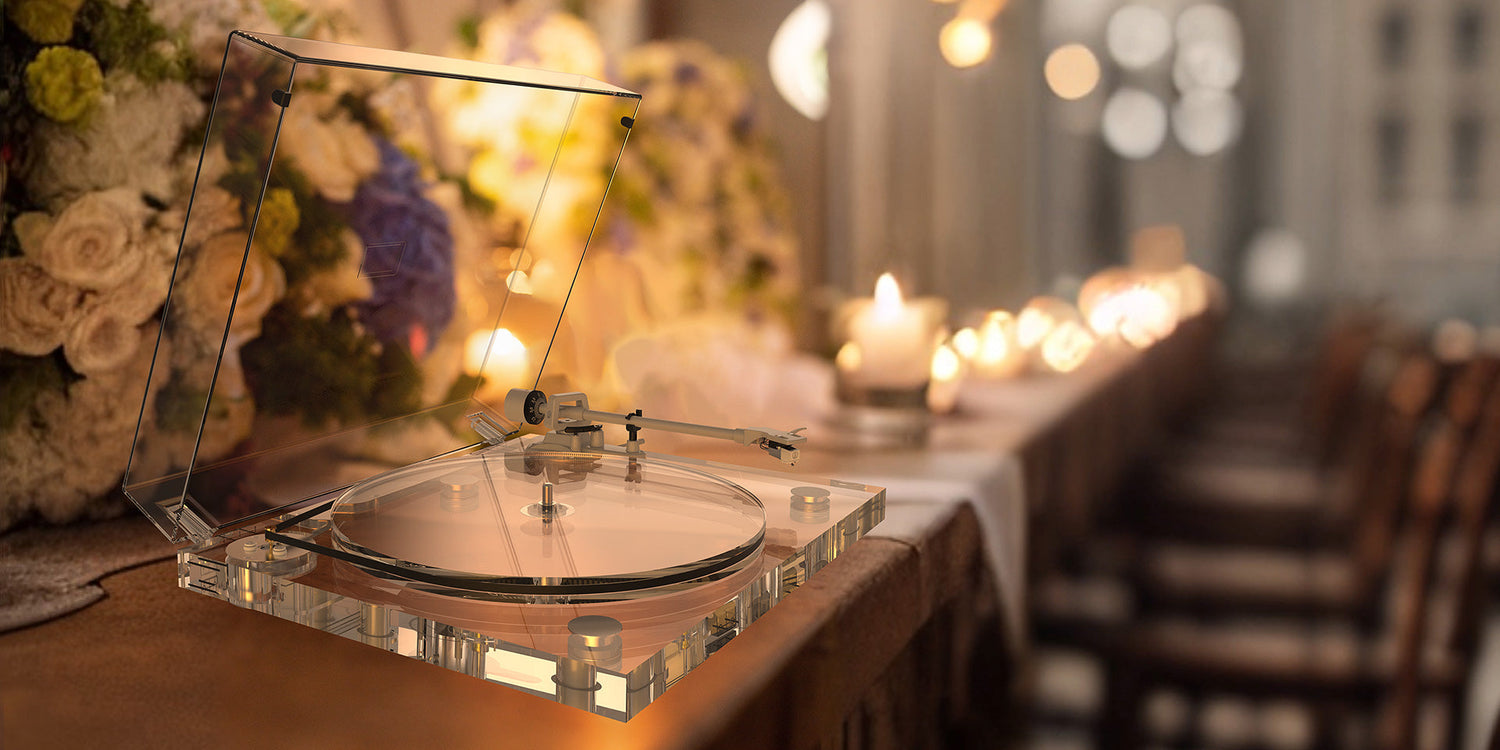
There was a time when a turntable was something you bought for one reason: to play records.
Today, that is still the main job. But it is no longer the only thing people expect from one.
A turntable often sits on a console in the living room, on a shelf in a bedroom, or on a desk in a home office. It is visible when you are not using it. The records next to it are visible, too. So is the tonearm, the platter, the dust cover, and whatever speakers you have chosen to complete the setup.
In other words, a turntable has become part of the room.
And that helps explain the growing interest in design-first audio: audio equipment designed not only to perform well, but also to look at home in the spaces where people actually live.
Your Turntable Doesn't Live in a Rack Anymore
Traditional hi-fi equipment often had an obvious visual language: wood veneer, black components, buttons, knobs, and stacks of separate boxes.
There is nothing wrong with that style. In fact, it remains timeless.
But modern listeners have a much wider range of choices.
A contemporary record player can be minimalist, compact, transparent, colorful, retro-inspired, or almost sculptural. Some designs deliberately hide their mechanics. Others do the opposite and make the spinning record part of the visual experience.
At the same time, major manufacturers are explicitly treating design as part of the listening experience. Sony's 2026 PS-LX5BT, for example, describes its minimalist styling as something designed to blend into and elevate the surrounding space.
The shift is subtle but important:
Audio equipment no longer has to disappear into the furniture. It can become part of the furniture's visual story.
Why Does the Design of a Turntable Matter?
At first, this might sound superficial.
After all, a beautiful turntable that cannot play a record properly is not a very useful piece of décor.
But design matters because a turntable is an unusually visible piece of technology.
A television can be mounted against a wall. An amplifier can be placed inside a cabinet. Streaming music can come from a device that you hardly notice.
A record player is different.
You physically walk over to it. You choose a record. You place it on the platter. You lower the tonearm. Then you leave the machine sitting there, spinning.
The entire process is part of the experience.
So it makes sense that people increasingly care about what the turntable looks like while they are using it—and while they are not.
What Makes a Turntable Look Modern?
There is no single definition of a “modern” record player.
But several design choices appear repeatedly.
Clean shapes
Modern furniture tends to favor simple silhouettes and fewer visual distractions. Contemporary turntables often follow the same idea.

Transparent materials
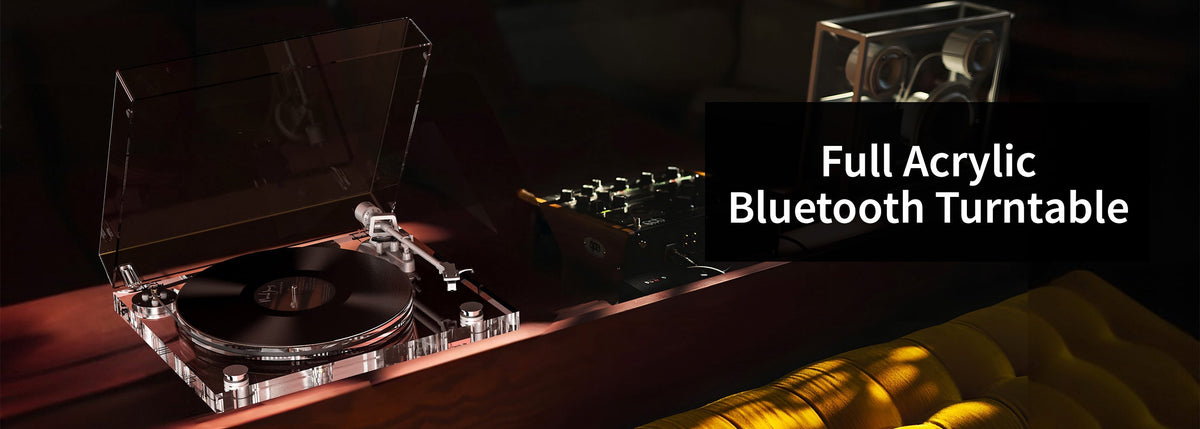
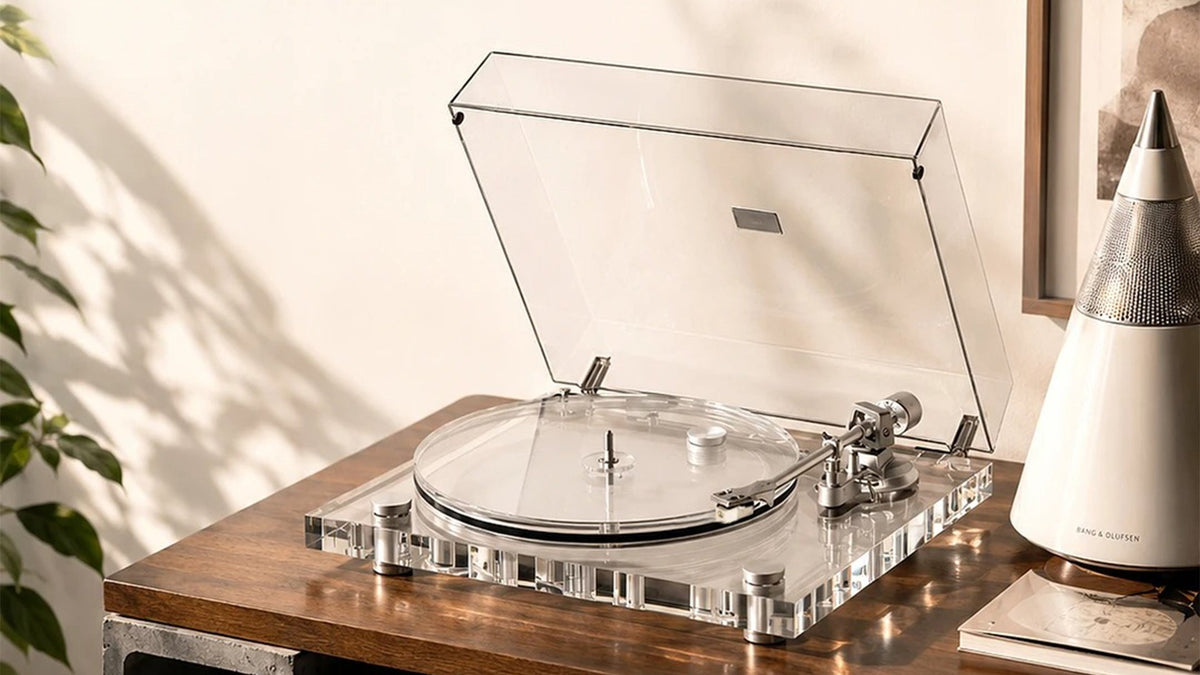
A clear or acrylic turntable creates a very different visual effect from a traditional wood-finished record player.
Instead of becoming a solid block of furniture, transparency allows the eye to see through the product and notice the record, platter, and mechanical movement.
Minimal controls
Modern designs often reduce the number of visible buttons and switches.
The goal is not necessarily to remove functionality. It is to make the important parts easier to understand without turning the product into a control panel.
Materials that become part of the aesthetic
Wood has warmth. Metal can feel precise and industrial. Acrylic feels light, clean, and contemporary.
The material itself becomes part of the identity of the turntable.
Why Acrylic Turntables Fit Modern Interiors So Well
This is where acrylic turntables have an interesting advantage.
A transparent turntable does not visually compete with everything around it in the same way a large opaque object can.
It can sit against a light wall, on a dark console, beside colorful album covers, or in a minimalist room without demanding that every other piece of furniture match it.
That makes a transparent record player surprisingly versatile.
There is also something inherently entertaining about seeing the record spin.
With a conventional opaque plinth, much of the mechanical side of playback disappears.
With a transparent design, more of the process is visible.
The record spins.
The platter moves.
The tonearm tracks across the surface.
The music is happening in front of you.
That is especially appealing for people who see vinyl listening as an experience rather than simply another way to deliver an audio signal.
A Turntable Can Be a Focal Point Without Taking Over the Room
Good interior design is not always about making everything disappear.
Sometimes a room needs one object with enough personality to draw attention.
A turntable can do that surprisingly well.
A stack of records brings color and typography into the space. Album covers can act almost like small pieces of artwork. Speakers add another visual element. The turntable itself becomes the center of the arrangement.
This is one reason a vinyl setup can feel more personal than a conventional wireless speaker sitting on a shelf.
A speaker plays music.
A vinyl setup tells visitors something about what you listen to.
That distinction is small, but it is part of the appeal.

The Vinyl Corner Is Becoming a Design Feature
You do not need an enormous listening room to create a dedicated vinyl space.
A small console or sideboard can be enough.
Think about the setup as a composition:
Turntable + speakers + records + storage + a little breathing room
The trick is not to fill every inch.
A few visible records can be more effective than an entire wall of albums. A simple stand can make the collection easier to browse. A lamp, plant, or piece of artwork can soften the technology and make the setup feel like part of the home rather than an equipment station.
And this is where accessories become surprisingly important.
A record stand is not only for storage.
It can determine whether your collection looks organized, decorative, or cluttered.
Clear acrylic record stands and turntable furniture are now available in designs intended specifically to work as modern home furnishings, combining vinyl storage with a turntable surface or display space.
The result is a more integrated approach to vinyl:
The record player, the records, and the furniture all belong to the same setup.
Should Your Turntable Match Your Speakers?
Not necessarily.
In fact, matching everything perfectly can sometimes make a room feel more like a showroom than a home.
Instead, think about visual relationships.
A transparent turntable can work with warm wood furniture because the acrylic does not visually compete with the wood.
A minimalist black speaker can provide contrast against a clear turntable.
A colorful album cover can become the strongest accent in an otherwise neutral setup.
The goal is not to make every component identical.
The goal is to make the combination feel intentional.

Design Should Never Replace Function
There is one important line worth drawing here:
A turntable should not be judged by appearance alone.
A great-looking record player still needs a solid playback system behind the design.
When comparing modern turntables, pay attention to things such as:
- cartridge and stylus
- tonearm design
- platter and drive system
- speed accuracy
- vibration control
- output options
- Bluetooth capability
- phono stage
- ease of setup
A beautiful acrylic turntable may catch your attention first. Its actual construction and playback components determine whether you will still enjoy it six months later.
The best design-first audio products do both jobs.
They look good enough to keep on display and function well enough to deserve the space they occupy.
What About the Speakers?
Speakers are often where a beautiful turntable setup becomes visually messy.
Fortunately, modern speaker options give you more flexibility.
A compact pair of powered speakers can create a clean setup without requiring a separate amplifier. Bluetooth speakers can reduce visible cabling even further, provided the turntable supports Bluetooth output.
This is another reason wireless connectivity is becoming so relevant to modern vinyl systems.
The fewer components you need to display, the easier it becomes to make the entire setup feel intentional.
That does not mean traditional wired systems are outdated.
A carefully arranged turntable, amplifier, and passive speakers can look fantastic too.
It simply means there is now more than one way to build a good-looking vinyl system.
How to Make a Turntable Look at Home
You do not need expensive furniture or a designer apartment.
A few simple principles go a long way.
Give the turntable some breathing room
Do not immediately surround it with every record, cable, accessory, and piece of equipment you own.
Display a few records
Choose albums you actually love.
The artwork can add personality to the room without making the collection feel chaotic.
Hide unnecessary cables
Cable management may sound boring, but it can have a surprisingly large impact on the overall appearance of a setup.
Use storage that fits the room
A record stand or shelf should make albums easy to access while complementing the furniture around it.
Let the turntable be visible
There is little point in buying an interesting-looking turntable and then hiding it behind a cabinet door.
Part of the appeal is seeing it.
Where Does the AudioKeeper GENESIS-V2 Fit?
For listeners who want their turntable to be part of the visual identity of a room, the AudioKeeper GENESIS-V2 takes a distinctly contemporary approach.
Its transparent acrylic construction makes the turntable itself part of the display rather than simply a piece of equipment placed inside it.
That works particularly well in minimalist and modern interiors, where transparency can create visual openness instead of adding another solid block to the room.
The GENESIS-V2 also combines that design approach with modern connectivity, giving owners the option of building a more traditional wired system or a cleaner wireless setup with compatible audio equipment.
That combination is ultimately what makes a design-first turntable interesting.
It is not about choosing between looks and function.
It is about expecting both.

The Turntable Is Becoming Part of the Home
The return of vinyl has brought an old listening ritual into a very different kind of home.
People are listening to records in apartments, bedrooms, home offices, reading corners, and minimalist living spaces. They want the physical experience of vinyl, but they do not necessarily want their room to look like a vintage hi-fi showroom.
That opens the door for a new generation of record players.
Some emphasize simplicity.
Some emphasize wireless connectivity.
Some emphasize sound.
And some make design a central part of the experience.
The most interesting modern turntables do not try to hide that they are pieces of technology.
They make the technology something you actually want to see.
And perhaps that is the real evolution of the record player:
It is no longer just something you use to play music. It can also be something you choose to live with.

Frequently Asked Questions
Why are turntables becoming part of home décor?
Turntables are usually visible pieces of equipment, so consumers increasingly consider their materials, shape, color, and overall appearance when choosing one. Modern designs can function as both audio equipment and a visual feature of the room.
Are acrylic turntables good for modern homes?
Yes. Transparent acrylic can create a clean, visually light appearance that works particularly well with minimalist and contemporary interiors. The actual performance of the turntable, however, depends on its full design and components rather than the material alone.
What is a design-first turntable?
A design-first turntable is a record player where visual design is treated as an important part of the product experience alongside playback performance and functionality.
How do I make my vinyl setup look better?
Start with a simple arrangement: give the turntable enough space, manage visible cables, display a small selection of records, and choose storage and speakers that complement the room rather than competing with it.
Should a turntable match the room?
It does not have to match perfectly. A well-designed turntable can either blend into the room or act as a deliberate focal point. The most important thing is that the overall combination feels intentional.






Leave a comment
All comments are moderated before being published.
This site is protected by hCaptcha and the hCaptcha Privacy Policy and Terms of Service apply.