
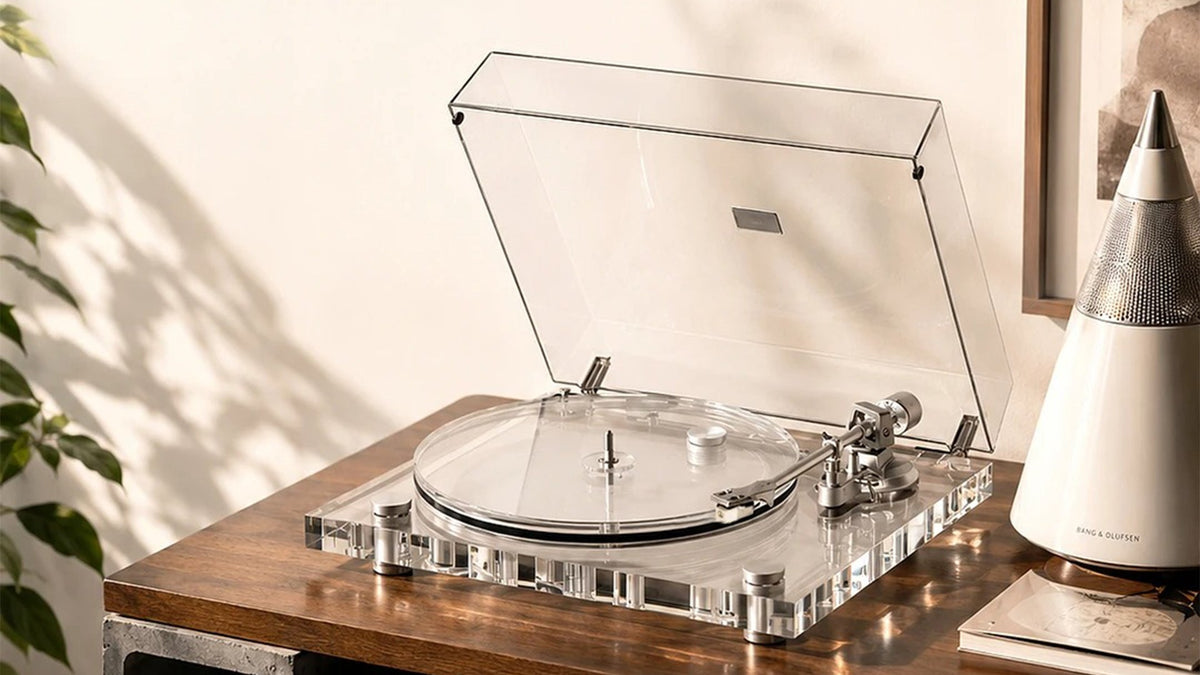
There is something oddly satisfying about watching a record spin on a transparent turntable.
You can see the platter moving beneath the record. You can see the tonearm tracking across the groove. Instead of hiding the mechanics inside a conventional cabinet, an acrylic turntable puts much of the engineering on display.
That is a big part of its appeal.
But there is a more interesting question behind the looks:
Does acrylic actually make a turntable better?
The honest answer is: not automatically.
Acrylic can be used in several different parts of a turntable, and its effect depends on how the material is integrated into the overall design. A good turntable is the result of many components working together—platter, plinth, tonearm, cartridge, motor, bearing, isolation, and electronics—not simply the material used for its exterior.
So let's look at what an acrylic turntable really is, why manufacturers use acrylic, and what matters when you're choosing one.
What Is an Acrylic Turntable?
An acrylic turntable is a record player that uses acrylic as a significant structural or visible material.
That can mean different things.
Some turntables use acrylic for the platter, the circular platform that supports the record. Others use it for the plinth, the main body or chassis of the turntable. Some combine acrylic construction with other materials.
And then there are full acrylic turntables, where the transparent material is a defining part of the overall design.
This distinction is worth making because an acrylic platter and an acrylic turntable are not quite the same thing.
Acrylic is also commonly known by names such as acrylic glass or PMMA (polymethyl methacrylate). It is a transparent plastic material that can be machined and polished into precise components while offering a very different visual character from wood, metal, or opaque composites.
In other words, "acrylic turntable" describes a design approach, not a guarantee of a particular sound.
Why Do Turntable Designers Use Acrylic?
Acrylic has two qualities that make it interesting for turntable design:
It is visually distinctive, and it can be engineered into substantial, precisely shaped components.
The first part is obvious.
The second is where things get more interesting.
Turntable design is largely about controlling unwanted movement and energy. The record needs to rotate consistently while the stylus traces extremely small movements in the groove. The motor, bearing, platter, tonearm, and surrounding environment can all introduce energy into the system.
That is why serious turntable manufacturers spend so much time thinking about rigidity, mass, isolation, and resonance.
Rega, for example, uses acrylic as part of the laminated plinth construction on its Planar 2 and Planar 3, while emphasizing the importance of rigidity and controlling unwanted resonance in the overall chassis design. Its engineering approach also shows why it is misleading to reduce turntable performance to one material alone.
Acrylic can therefore be one ingredient in a carefully engineered design.
It is not a magic ingredient.
Does Acrylic Make a Turntable Sound Better?
Not by itself.
This is probably the most important thing to understand before shopping for an acrylic record player.
A turntable's sound and tracking performance depend on the interaction of many parts:
- cartridge and stylus
- tonearm
- platter
- main bearing
- motor and drive system
- plinth or chassis
- isolation
- tracking force
- phono stage
- amplification and speakers
Changing one material does not automatically improve all of those things.
A useful example comes from high-end turntable design. Rega's current range uses several different material strategies—from acrylic-laminated plinths to glass and ceramic platters, lightweight composite structures, and carbon-fiber constructions. The common theme is not "one perfect material"; it is controlling the mechanical behavior of the complete system.
So when someone says, "Acrylic sounds better," the more accurate question is:
What part of the turntable is acrylic, and how has that material been engineered into the design?
That is a much more useful way to evaluate a product.
Acrylic Platter vs. Acrylic Plinth
These two terms can sound interchangeable, but they serve different purposes.
Acrylic Platter
The platter is the rotating platform that supports the record.
An acrylic platter can contribute to the overall mechanical behavior of the rotating assembly while also creating the distinctive transparent appearance associated with many modern acrylic record players.
Because the platter rotates directly beneath the record, its dimensional accuracy, balance, bearing relationship, and stability matter more than simply being transparent.
A well-made platter should support the record consistently and rotate predictably.
Acrylic Plinth
The plinth is the main supporting structure of the turntable.
Its job is not merely to look good. It provides the mounting platform for components such as the tonearm and bearing and forms part of the turntable's mechanical structure.
This is why rigidity and vibration management matter so much.
Rega's design philosophy offers a useful real-world example: its acrylic-laminated Planar 3 plinth is paired with a bracing structure specifically positioned between the tonearm mounting point and main bearing. Rega says this structure is designed to increase rigidity and reduce unwanted resonance.
The takeaway is simple:
Acrylic is a material. The engineering is in how you use it.
Why Do Acrylic Turntables Look So Different?
This is the part that has nothing to do with laboratory measurements—and it is still important.
A traditional wooden or composite turntable usually reads visually as a solid object.
An acrylic turntable behaves differently.
Transparency reduces the visual weight of the chassis and allows the record and moving components to remain visible. The result can feel less like a conventional piece of electronics and more like a design object.
That makes a clear turntable particularly attractive in modern interiors.
It can sit beside:
- minimalist furniture
- contemporary speakers
- colorful album artwork
- metal shelving
- warm wood furniture
- neutral interiors
without forcing the entire room to adopt the visual language of the turntable.
That flexibility is one reason transparent record players have developed a distinct niche within modern vinyl setups.

Are Acrylic Turntables Stable?
They can be—but stability is not determined by transparency.
A turntable needs a stable platform, reliable feet or isolation, a properly supported bearing, and a platter and motor system that work together consistently.
The overall mass and construction also matter.
For example, AudioKeeper's GENESIS-V2 uses a 25 mm acrylic base and a 15 mm acrylic platter, with a total turntable weight of 8.45 kg. Its design also incorporates high-isolation metal feet and a belt-driven system.
Those specifications are useful because they show what a complete design looks like.
The correct conclusion isn't:
"Acrylic is heavy, therefore acrylic turntables are stable."
It is:
Acrylic construction can be combined with appropriate mass, isolation, bearing design, and drive-system engineering to create a stable turntable.
That distinction matters.

What About Resonance?
Resonance is one of those words that appears constantly in turntable marketing, often without much explanation.
Put simply, every physical structure can respond to vibration and energy.
A turntable has several potential sources:
- motor vibration
- bearing movement
- speakers in the same room
- external vibrations
- the stylus and record interface itself
Good turntable design tries to keep unwanted energy from interfering with the delicate stylus-groove relationship.
Different manufacturers use different strategies.
Some favor lightweight rigid structures. Others use more massive platforms. Some combine materials. Some focus heavily on isolation.
Rega, for example, explicitly describes its lightweight rigid plinth approach as a way to manage unwanted resonance and energy transmission, while its higher-end models combine different materials and bracing strategies rather than relying on one substance alone.
So there is no universal rule such as:
"More acrylic = less resonance."
Turntables are systems, and their mechanical behavior depends on the system.
Acrylic vs. Wooden Turntables
This comparison is coming up more often because acrylic and wood represent two very different design philosophies.
A wooden turntable tends to feel:
- warm
- traditional
- furniture-like
- visually familiar
An acrylic turntable tends to feel:
- light
- contemporary
- minimalist
- visually distinctive
From a performance standpoint, it is not sensible to declare one material universally superior.
A carefully engineered wooden turntable can perform extremely well.
A carefully engineered acrylic turntable can perform extremely well.
The better question is what the particular turntable does with its chosen materials.
This is also why the specification sheet should never stop at "acrylic" or "wood."
Look at the complete system.
What Should You Look For in an Acrylic Turntable?
The transparent body is probably what catches your eye first.
It shouldn't be the last thing you evaluate.
1. Look at the tonearm
The tonearm needs to maintain consistent tracking across the record.
Check its construction, effective length, adjustment options, and compatibility with the cartridge system.
2. Look at the cartridge
The stylus and cartridge are directly responsible for reading the groove.
A beautiful chassis cannot compensate for a poorly matched or poorly maintained cartridge.
3. Check the drive system
Most home turntables use either belt drive or direct drive.
Neither should automatically be treated as "better" in every situation. What matters is how the motor, platter, bearing, and speed control are engineered together.
4. Check speed performance
A turntable intended for normal vinyl playback should maintain the correct rotational speed.
For most modern record collections, the important speeds are 33⅓ RPM and 45 RPM.
5. Check isolation
Good feet and a stable surface can matter enormously.
Even an excellent turntable can struggle if it is placed on a surface that transmits strong vibration.
6. Check the connectivity
Modern turntables are not limited to one type of setup.
Depending on the model, you may find:
- RCA output
- built-in phono preamp
- Bluetooth transmission
- USB output
Think about the system you already own and the system you may want in the future.
7. Don't forget the practical details
Acrylic looks beautiful when clean.
It also makes fingerprints, dust, and scratches easier to notice.
So consider the quality of the dust cover, your cleaning habits, and where the turntable will live.

How Do You Clean an Acrylic Turntable?
This is one area where transparency demands a little extra care.
Acrylic surfaces can attract dust through static electricity, and improper cleaning can create scratches or surface marks. PLEXIGLAS® manufacturer guidance recommends using a soft, lint-free cloth or suitable sponge with water and a small amount of mild dishwashing detergent when necessary; it also warns against rubbing the acrylic completely dry, which can build up static and attract more dust.
For an acrylic turntable, a sensible routine is simple:
Use a soft cloth. Avoid abrasive materials. Don't attack the surface with harsh household cleaners.
And because the transparent body is part of the visual experience, regular light cleaning is usually better than waiting until a thick layer of dust has accumulated.
AudioKeeper's own care instructions similarly recommend a clean, soft cloth for the ICE1 acrylic surface and advise keeping the turntable away from direct sunlight and humid environments.
Is an Acrylic Turntable Right for You?
An acrylic turntable may be a particularly good fit if you want your record player to do more than sit quietly in the corner.
It can make sense for someone who:
Wants a contemporary look.
A transparent turntable can work naturally with modern furniture and interiors.
Likes seeing the mechanics.
The spinning record and visible components become part of the experience.
Wants a statement piece.
Some people want audio equipment to disappear. Others want it to be seen.
Is building a modern vinyl setup.
Acrylic works naturally with minimalist furniture, wireless speakers, and clean cable layouts.
Still cares about performance.
A good acrylic turntable should be evaluated like any other turntable: by the complete engineering, not by its material alone.
The AudioKeeper GENESIS-V2 Approach
The AudioKeeper GENESIS-V2 is designed around the idea that the turntable itself can be part of the listening environment.
Its fully transparent acrylic construction makes the record and mechanical movement visible, while its 25 mm acrylic base and 15 mm acrylic platter give the design a substantial physical presence rather than making transparency the only visual trick.
Underneath the aesthetics, it uses a belt-drive system, a straight aluminum-alloy tonearm, an Audio-Technica ATN-3600L cartridge, adjustable counterweight, high-isolation metal feet, and a built-in switchable phono preamp. It also offers RCA output and Bluetooth 5.3 transmission for modern wireless setups.
That combination illustrates an important point about acrylic turntables:
The material gets people to look. The engineering gives them a reason to keep listening.

So, Are Acrylic Turntables Actually Worth It?
Yes—when you choose the whole turntable, not just the material.
Acrylic can offer a distinctive combination of visual transparency, structural possibilities, and contemporary design. It can make a turntable feel lighter, more open, and more at home in a modern room.
But "acrylic" should never be the entire buying argument.
The best acrylic record player for you is one where the design, tonearm, cartridge, platter, motor, isolation, connectivity, and overall setup make sense together.
That is what turns an attractive object into a good turntable.
And that may be the most interesting thing about acrylic designs in the first place.
They remind us that a turntable can be both:
a piece of audio equipment—and something worth putting on display.
Frequently Asked Questions
Are acrylic turntables good?
They can be. Acrylic itself does not guarantee better sound, but it can be part of a well-engineered turntable design. Overall performance depends on the platter, tonearm, cartridge, motor, bearing, isolation, and other components.
Do acrylic turntables sound better than wooden turntables?
Not necessarily. There is no universal rule that acrylic always sounds better than wood. The design and engineering of the complete turntable matter more than the material name alone.
What is an acrylic turntable?
An acrylic turntable is a record player that uses acrylic as a significant part of its platter, plinth, or overall structure. Full acrylic models use the transparent material as a defining part of their design.
Does an acrylic platter improve sound?
Not automatically. An acrylic platter can be engineered for particular mechanical characteristics, but its effect depends on the entire turntable design and how the platter interacts with the bearing, motor, record, and rest of the system.
Are clear turntables practical?
Yes. A clear turntable can be just as practical as other turntables when its mechanical and electrical components are properly designed. The main difference is that its transparent surfaces may require more attention to dust, fingerprints, and scratches.
How do you clean an acrylic turntable?
Use a soft, lint-free cloth and mild cleaning methods suitable for acrylic. Avoid abrasive materials and harsh cleaners, and follow the manufacturer's care instructions for the specific model.








Leave a comment
All comments are moderated before being published.
This site is protected by hCaptcha and the hCaptcha Privacy Policy and Terms of Service apply.