
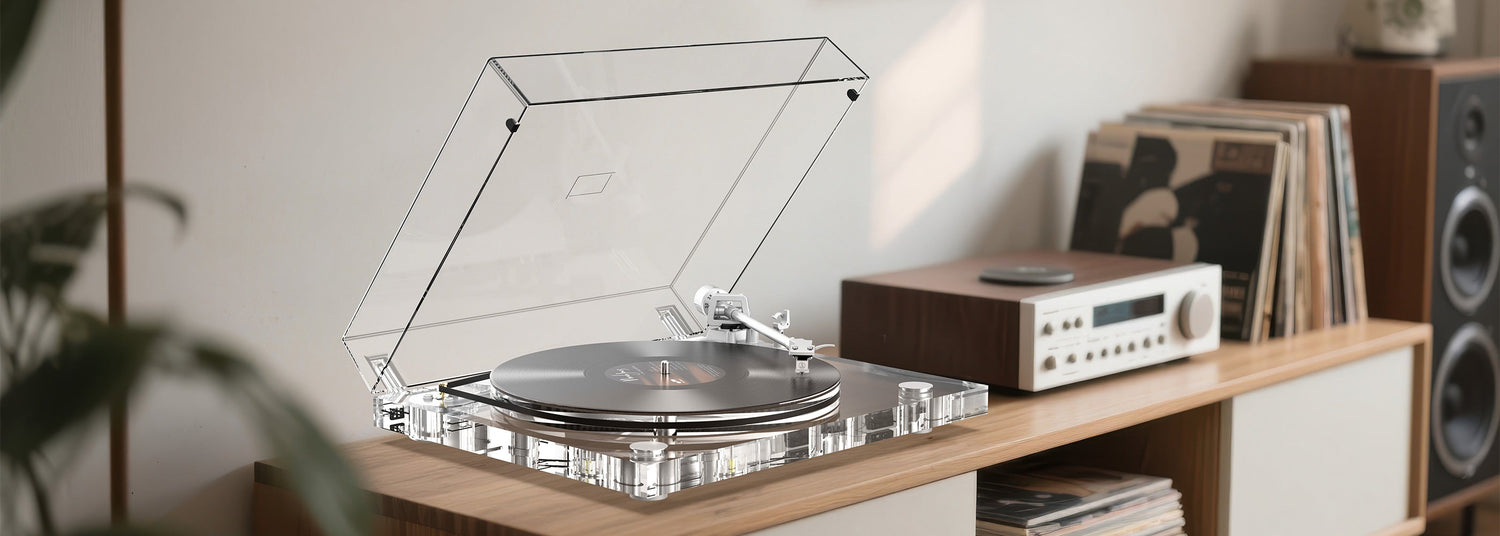
Do you need an amplifier for a turntable?
Not always.
It depends on what you connect to the turntable.
If you use passive speakers, you'll need an amplifier to power them. If you use powered speakers, the amplifier is already built into the speakers. And if you're sending the turntable's audio wirelessly to compatible Bluetooth headphones or speakers, you may not need a separate amplifier at all.
The confusing part is that there are actually two different things people often mean when they say "amplifier":
A phono preamp, which prepares the turntable's low-level signal, and
a power amplifier, which provides enough power to drive passive speakers.
Understanding the difference makes choosing a vinyl setup much easier.
The Simple Answer: It Depends on Your Speakers
Think about your system in terms of where the amplification happens.
Turntable + Passive Speakers
You need an amplifier.
Turntable → amplifier → passive speakers
Passive speakers do not have their own built-in power amplifier, so they rely on an external amplifier or receiver.
Turntable + Powered Speakers
You usually don't need a separate amplifier.
Turntable → powered speakers
Powered speakers already contain their own amplification.
Turntable + Bluetooth Speaker
For a compatible wireless setup, you generally don't need a separate amplifier.
Turntable → Bluetooth → Bluetooth speaker
The speaker handles its own amplification.
That's the basic picture.
But there is one more piece worth understanding.
What Is a Phono Preamp?
A phono preamp, or phono stage, is not the same thing as a power amplifier.
A phono cartridge produces a relatively low-level signal that needs appropriate amplification and equalization before it can be sent to a standard line-level input.
The phono stage can be located in different places.
It may be:
- built into the turntable
- built into an amplifier or receiver
- provided by a separate external phono preamp
So a system can look like:
Turntable → built-in phono stage → powered speakers
or:
Turntable → external phono preamp → amplifier → passive speakers
or:
Turntable → amplifier with phono input → passive speakers
These setups all solve the same basic signal problem in different ways.
Why Do Some Turntables Have Built-In Phono Preamps?
A built-in phono stage makes a turntable easier to connect to modern audio equipment.
Without one, a turntable's phono output generally needs to go to a dedicated phono input or external phono stage.
With a built-in phono stage, the turntable may provide a line-level output that can connect directly to compatible powered speakers or another line-level input.
Some models also allow you to switch between phono and line output.
That can make the turntable much more flexible as your system changes.
So, What Does the Amplifier Actually Do?
Once the signal has been brought to the appropriate level, the power amplifier's job is straightforward:
It provides the power needed to drive passive speakers.
This is why passive speakers cannot normally be connected directly to a standard turntable output.
The turntable provides the source.
The amplifier provides the power.
The passive speakers turn that amplified electrical signal into sound.
Once you think of the system in those terms, the equipment starts making a lot more sense.
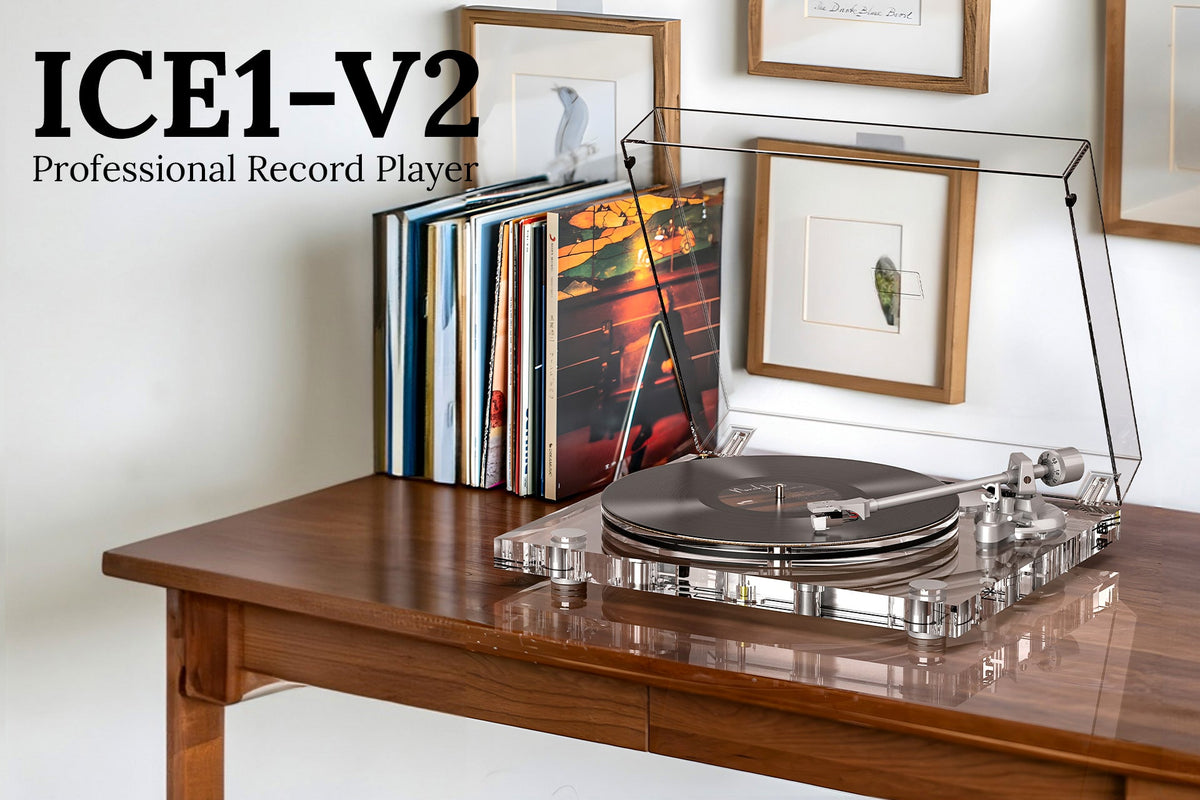
Do You Need an Amplifier for an Acrylic Turntable?
The answer doesn't change just because a turntable is made from acrylic.
Whether you're using a traditional wooden turntable, a metal-bodied model, or a transparent acrylic turntable, the amplifier requirement depends on the rest of the audio system.
For example, the AudioKeeper GENESIS-V2 provides Bluetooth transmission and RCA output, while also including a built-in phono preamp. That allows it to work with several different types of setups.
You could use:
GENESIS-V2 → Bluetooth → compatible speaker
or:
GENESIS-V2 → RCA → powered speakers
or integrate it into a more traditional system with an appropriate amplifier and passive speakers.
The turntable doesn't dictate the entire system.
Your other components do.
What If You Already Own an Amplifier?
Then the important question is whether the amplifier has a phono input.
If it does, the setup may be as simple as:
Turntable → phono input on amplifier → passive speakers
If it does not have a phono input, you'll need to determine whether the turntable has a built-in phono stage or add an external phono preamp.
For example:
Turntable → line output → amplifier → passive speakers
could work when the turntable provides the required phono-stage processing.
Always check the actual connections and switch settings on your equipment rather than assuming two RCA ports serve the same purpose.
What Is the Simplest Vinyl Setup?
For someone buying their first turntable, simplicity is often a good goal.
One straightforward option is:
Turntable + powered speakers
You have two main components, no separate power amplifier, and fewer connections to think about.
Another simple option is:
Bluetooth turntable + Bluetooth speaker
This reduces visible cabling even further.
For someone who wants more flexibility and enjoys building audio systems, a traditional setup can be more rewarding:
Turntable + phono stage + amplifier + passive speakers
It has more components, but also gives you more opportunities to choose and upgrade each part.
Which Setup Is Right for You?
| Setup | Separate Amplifier Needed? | Best For |
|---|---|---|
| Turntable + passive speakers | Yes | Traditional stereo systems |
| Turntable + powered speakers | No | Simple wired setups |
| Bluetooth turntable + Bluetooth speaker | No | Minimal wireless systems |
| Turntable + Bluetooth headphones | No, for the wireless connection | Private listening |
| Turntable + amplifier + passive speakers | Yes | Flexible hi-fi systems |
There is no requirement to build the most complicated setup.
In fact, the simplest system may be the best one if it removes unnecessary equipment and gets you listening sooner.
Common Mistakes to Avoid
Mistake 1: Assuming RCA automatically means you can connect everything
RCA describes the connector, not the signal level.
A phono-level output and a line-level output are not necessarily interchangeable.
Mistake 2: Buying passive speakers without an amplifier
Passive speakers need power from an amplifier or receiver.
Mistake 3: Buying a phono preamp when you already have one
Check whether the turntable or amplifier already includes a phono stage.
Mistake 4: Assuming every turntable works directly with powered speakers
Check whether the turntable provides the appropriate line-level output or requires additional equipment.
Mistake 5: Choosing equipment before deciding on the system
Start with the setup you want.
Then buy components that work together.
Do You Need a Separate Amplifier With GENESIS-V2?
Not necessarily.
For a wireless setup, compatible Bluetooth speakers or headphones can receive audio directly from the GENESIS-V2.
For a simple wired setup, compatible powered speakers can receive the turntable's RCA output without a separate power amplifier, provided the signal is configured appropriately.
For a traditional passive-speaker system, an amplifier is still required.
That flexibility is one of the advantages of having multiple connection options.
The Bottom Line
You do not automatically need an amplifier just because you own a turntable.
Ask two questions:
What speakers am I using?
and
Where is the phono stage?
If you're using passive speakers, you'll need an amplifier.
If you're using powered speakers, the amplification is already built in.
If you're using a compatible Bluetooth speaker or headphones, you may not need a separate amplifier at all.
And if you're unsure about the phono stage, check whether it is built into the turntable, amplifier, or an external component.
Once you understand those two pieces—the phono stage and the power amplifier—most turntable connection questions become much easier.
You don't need a room full of equipment to enjoy vinyl.
You just need the right pieces in the right order.
Turntable first. Music second. Unnecessary boxes last.






Leave a comment
All comments are moderated before being published.
This site is protected by hCaptcha and the hCaptcha Privacy Policy and Terms of Service apply.