
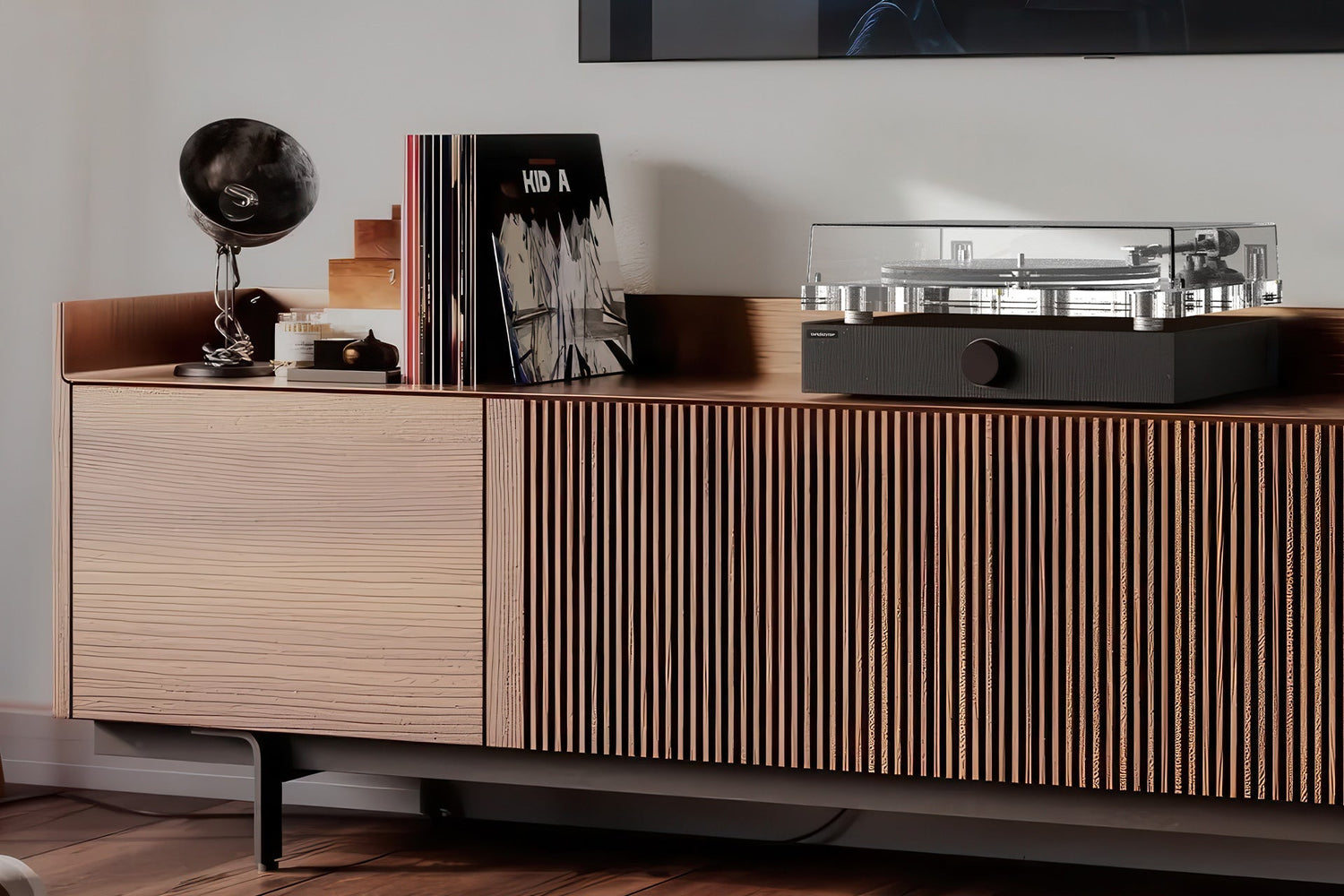
A vinyl setup used to come with an expectation: turntable, amplifier, speakers, cables—and probably a cabinet large enough to hold everything.
That setup still works beautifully. But it is no longer the only way to listen to records.
Bluetooth has opened up another way to build a vinyl system, giving listeners more freedom to choose where and how they listen. [Learn more about how Bluetooth is changing vinyl listening →]
Today, a wireless vinyl setup can be surprisingly simple.
Today, a wireless vinyl setup can be surprisingly simple. Depending on the equipment you choose, a turntable can connect to Bluetooth speakers or headphones without running speaker cables across the room.
The trick is knowing what each piece of equipment actually does.
Because "wireless" does not mean "plug anything into anything."
Here is how to build a modern vinyl system without turning your living room into an equipment rack.
Start With One Question: How Do You Want to Listen?
Before buying a turntable, decide what you want the listening experience to look like.
Do you want music filling the room?
Do you want headphones for private listening?
Do you want the simplest possible setup?
Or do you want the flexibility to use both wired and wireless equipment?
Your answer determines what comes next.
A modern vinyl system can be built in several ways:
Turntable → Bluetooth speaker
Turntable → Bluetooth headphones
Turntable → RCA → powered speakers
Turntable → phono preamp → amplifier → passive speakers
There is no single "correct" setup.
There is only the setup that makes sense for your room, equipment, and listening habits.
Setup 1: Turntable + Bluetooth Speaker
This is one of the simplest ways to create a wireless vinyl system.
The signal path is straightforward:
Vinyl record → turntable → Bluetooth transmitter → Bluetooth speaker
The turntable reads the record and transmits the audio wirelessly. The Bluetooth speaker receives it and plays the music.
What You Need
You need:
- a turntable with Bluetooth output/transmission
- a compatible Bluetooth speaker
- vinyl records
That's it.
No separate stereo amplifier is required for the Bluetooth connection itself.
Why Choose This Setup?
It works particularly well when:
- you already own a Bluetooth speaker
- you live in a smaller space
- you want fewer cables
- you move your listening setup around
- you are buying your first turntable
It is also one of the easiest ways to add vinyl to a room without rebuilding your entire audio system.
One Important Detail
Make sure the turntable actually supports Bluetooth transmission.
Some Bluetooth-enabled audio products are designed primarily to receive audio from a phone or another source. That does not necessarily mean they can transmit the sound from a vinyl record to a Bluetooth speaker.
Always check the manufacturer's specifications.
Setup 2: Turntable + Bluetooth Headphones
Want to listen to a record without filling the room with music?
A wireless headphone setup can be even simpler.
Turntable → Bluetooth transmitter → Bluetooth headphones
This can be particularly useful for:
- late-night listening
- apartments
- shared living spaces
- focused album listening
- listeners who prefer headphones
The experience is slightly different from using speakers.
You lose some of the room-filling character of a traditional stereo system, but you gain privacy and flexibility.
What Should You Check?
Again, the critical feature is Bluetooth transmission from the turntable.
The headphones need to support a compatible Bluetooth audio connection.
Pairing can also be affected by nearby Bluetooth devices, so if your turntable is having trouble finding the correct headphones, temporarily disabling unused Bluetooth connections can help.
Setup 3: Turntable + Powered Speakers
Here is where the term "wireless vinyl setup" can get confusing.
A setup does not have to be completely wireless to be modern.
Powered speakers are a great example.
A powered speaker has its own built-in amplifier, which means you do not need a separate amplifier or receiver.
The basic wired setup is:
Turntable → RCA → powered speakers
Or, with compatible equipment:
Turntable → Bluetooth → powered speakers
Why Are Powered Speakers Popular?
They offer a good middle ground.
You still have a straightforward two-piece system, but you can keep the audio chain wired if that is your preference.
They are often a practical choice for:
- apartments
- desks
- bedrooms
- small living rooms
- first-time vinyl systems
They can also leave you with more control than a single Bluetooth speaker.
Setup 4: Turntable + Amplifier + Passive Speakers
This is the classic stereo approach.
The signal path looks something like:
Turntable → phono stage → amplifier → passive speakers
The amplifier provides power to the passive speakers, while the phono stage prepares the turntable's low-level phono signal for the rest of the audio system when required.
This setup requires more equipment, but it can also give you more flexibility.
You can choose your:
- amplifier
- speakers
- phono stage
- cables
- turntable
independently.
That makes it attractive to listeners who want to build a system gradually.
It also gives you much more room to upgrade individual components later.
Do You Need a Phono Preamp?
This is one of the most common questions when setting up a turntable.
The answer is:
It depends on the turntable and the equipment connected to it.
A phono cartridge produces a relatively low-level signal that generally needs phono-stage amplification and equalization before it can be fed into a normal line-level input.
Some turntables have a built-in phono preamp.
Some external phono stages sit between the turntable and amplifier or powered speakers.
Some systems allow the user to switch between phono and line output.
That means you should check your specific equipment before connecting anything.
A typical setup might look like:
Turntable with built-in phono stage → powered speakers
or:
Turntable → external phono preamp → amplifier
or:
Turntable → amplifier with phono input
The important thing is to make sure the signal is going into the correct type of input.
Bluetooth or RCA: Which Should You Choose?
The good news is that you don't necessarily have to choose one forever.
Bluetooth is convenient.
RCA is flexible and remains the standard wired connection for many home audio systems.
Choose Bluetooth when you want:
A cleaner room
Fewer long cables can make the setup visually simpler.
Flexible speaker placement
Your speaker does not have to sit directly beside the turntable.
Headphone listening
Wireless headphones can make private vinyl sessions much easier.
A simple setup
Bluetooth can reduce the number of separate components you need.
Choose RCA when you want:
A traditional stereo system
RCA integrates naturally with amplifiers, receivers, and powered speakers.
A wired signal path
Some listeners simply prefer wired connections.
More component-level control
A wired system allows you to choose and upgrade individual parts more easily.
Choose both when you want flexibility
A turntable offering both Bluetooth and RCA output can be especially useful.
You can start with Bluetooth today and add or switch to a wired setup later.
That can be a smart approach for someone who is not sure how their vinyl system will evolve.
How to Choose Speakers for a Wireless Vinyl Setup
Your turntable is only half the equation.
The speaker determines how you ultimately hear the music, so it deserves just as much attention.
Bluetooth Speakers
Best for:
- simplicity
- portability
- small spaces
- wireless listening
Make sure the speaker can receive audio from the turntable's Bluetooth transmitter.
Powered Bookshelf Speakers
Best for:
- fuller stereo presentation
- compact home systems
- listeners who want a dedicated left/right speaker setup
These speakers contain their own amplification, so there is no need for a separate stereo amplifier.
Passive Speakers
Best for:
- traditional stereo systems
- flexible component selection
- people who want to upgrade their audio chain over time
They do require an appropriate amplifier.
How to Build a Wireless Vinyl Setup in a Small Room
A small apartment does not mean you need to give up a proper vinyl system.
In fact, a smaller room can make a compact setup particularly appealing.
A simple arrangement might be:
Acrylic turntable + compact Bluetooth speaker
or:
Turntable + powered bookshelf speakers
or:
Turntable + Bluetooth headphones
Keep the turntable on a stable, level surface and avoid placing it immediately beside a speaker if strong vibrations are reaching the turntable.
A good setup is often less about how much equipment you can fit into the room and more about how little equipment you actually need.
What About a Modern Vinyl Setup With Both Wireless and Wired Audio?
This is arguably the most flexible approach.
Imagine a system where:
Bluetooth = everyday convenience
RCA = future expansion
You might listen casually through Bluetooth most of the week, then connect the turntable to a more traditional stereo system when you want to.
This hybrid approach is particularly useful if your audio preferences are still evolving.
Maybe you start with a Bluetooth speaker.
A year later, you buy powered bookshelf speakers.
Later still, you decide to build a more traditional stereo system.
A turntable with multiple output options can grow with you.
A Modern Example: AudioKeeper GENESIS-V2
The AudioKeeper GENESIS-V2 is designed for exactly this kind of flexible setup.
Its transparent acrylic construction gives it a distinctly modern visual presence, while Bluetooth and RCA connectivity allow it to work with different listening systems.
For a simple wireless setup, GENESIS-V2 can transmit audio to a compatible Bluetooth speaker or Bluetooth headphones.
For a wired system, its RCA output can be connected to compatible powered speakers, a phono stage, or another appropriate audio component depending on the setup.
The result is a turntable that does not force you to decide everything on day one.
Start simple.
Change the speakers later.
Keep the option of going wired.
That flexibility can be more valuable than choosing the most complicated system from the beginning.
Three Simple Setups Worth Considering
Still not sure which direction makes sense?
Here is a simple way to think about it.
| Your Priority | Recommended Setup | Why |
|---|---|---|
| Simplest possible system | Turntable + Bluetooth speaker | Few components and minimal cabling |
| Better compact stereo | Turntable + powered speakers | Dedicated stereo speakers without a separate amplifier |
| Traditional hi-fi | Turntable + phono stage/amplifier + passive speakers | Maximum component flexibility |
| Private listening | Turntable + Bluetooth headphones | Wireless headphone listening |
| Flexibility | Bluetooth + RCA turntable | Easy wireless setup with a wired upgrade path |
The "best" setup depends less on the price of each component than on whether the whole system works together.
Common Mistakes to Avoid
Mistake 1: Assuming every Bluetooth turntable transmits audio
Bluetooth is not automatically two-way.
Check whether the turntable supports Bluetooth output.
Mistake 2: Connecting a turntable directly to passive speakers
Passive speakers need an amplifier.
They cannot normally be driven directly by a standard turntable output.
Mistake 3: Ignoring the phono stage
Before connecting the turntable, find out whether the turntable, amplifier, or external component provides the necessary phono stage.
Mistake 4: Putting the turntable somewhere unstable
A turntable needs a stable surface.
A beautiful setup can still perform poorly if the turntable is sitting on a shaky or highly resonant surface.
Mistake 5: Buying equipment first and planning the system later
It is better to decide on your listening setup first.
Then buy equipment that fits it.
A Wireless Vinyl Setup Can Still Feel Like Vinyl
There is sometimes an assumption that a wireless turntable makes the vinyl experience less authentic.
But the important part of vinyl does not disappear when you remove a cable.
The record is still physical.
The stylus still traces the groove.
You still have to choose an album, put it on the platter, and start playback.
Bluetooth simply changes how the audio travels from the turntable to the listening device.
For some people, that is a worthwhile trade.
For others, a wired stereo remains preferable.
Neither approach is wrong.
The best setup is the one that makes you want to keep listening.
Final Thoughts
Building a modern wireless vinyl setup does not require abandoning traditional audio equipment.
It is really about choosing the right combination of components.
For the simplest experience, a Bluetooth turntable and compatible speaker may be all you need.
For a compact stereo system, powered speakers are a practical next step.
For a more traditional setup, an amplifier, phono stage, and passive speakers offer greater flexibility.
And for listeners who do not want to commit to one approach, a turntable with both Bluetooth and RCA output can provide the best of both worlds.
Vinyl may be an old format.
Your listening setup doesn't have to be.
Frequently Asked Questions
Can I connect a turntable directly to a Bluetooth speaker?
Yes, when the turntable supports Bluetooth audio transmission and the speaker supports compatible Bluetooth reception.
Do I need an amplifier for a Bluetooth turntable?
Not necessarily. If you are sending audio to a compatible Bluetooth speaker or headphones, a separate amplifier is generally not required for that wireless connection.
Do I need powered speakers for a turntable?
No. You can use passive speakers with an appropriate amplifier. Powered speakers simply have the amplification built in, which can make a compact setup simpler.
Can I use RCA and Bluetooth with the same turntable?
Some turntables support both. Having both outputs can give you flexibility between wireless listening and a traditional wired system.
Can Bluetooth headphones work with a turntable?
Yes, provided the turntable supports Bluetooth transmission and the headphones are compatible with the turntable's Bluetooth connection.
What is the easiest vinyl setup for a beginner?
A turntable with built-in phono functionality and Bluetooth output paired with compatible powered or Bluetooth speakers can be one of the simplest ways to get started. Always check the exact connectivity and phono-stage requirements of the equipment you choose.






Leave a comment
All comments are moderated before being published.
This site is protected by hCaptcha and the hCaptcha Privacy Policy and Terms of Service apply.