
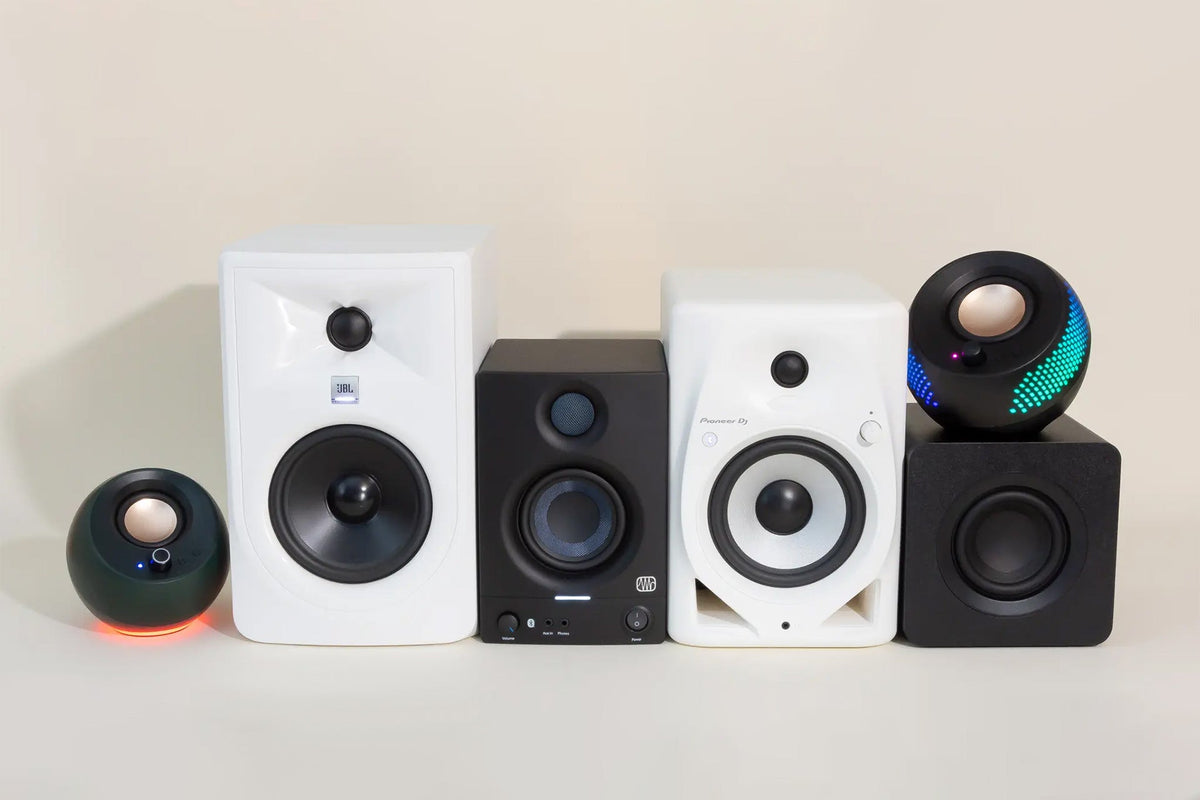
A small room doesn't mean you need small ambitions when it comes to vinyl.
In fact, a compact listening space can be a great place for a simple record player and a good pair of speakers. The trick is choosing speakers that fit the room instead of buying the biggest ones you can afford.
For most small vinyl setups, powered bookshelf speakers are a practical starting point. They combine amplification and speakers in one system, take up less space, and can connect directly to a compatible turntable.
But size isn't the only thing that matters.
Start With the Room, Not the Speaker
Before looking at specifications, look at the space where you'll actually listen.
Is it a bedroom? A home office? A small apartment living room? Maybe a corner of a larger room?
These situations don't require the same setup.
In a smaller room, oversized speakers can take up valuable space without necessarily giving you a better listening experience. Compact bookshelf or desktop speakers are often easier to position and can provide plenty of sound for near-field or moderate-distance listening.
Think about your normal listening position, too.
If you're sitting a few feet away from the speakers at a desk or in a reading chair, you're building a very different system from one designed to fill a large open-plan living room.

Powered or Passive?
This is one of the first decisions you'll run into.
Powered speakers have amplification built in. That means you can connect a compatible audio source directly to them without buying a separate amplifier.
For a small vinyl setup, that's a major advantage.
A basic system might look like:
Turntable → Powered speakers
Simple, compact, and easy to live with.
Passive speakers, on the other hand, require an amplifier or receiver. They can be an excellent choice if you want to build a more traditional or expandable stereo system, but they also introduce another piece of equipment into a small room.
If your priority is simplicity, powered speakers usually make more sense.
If you're planning a larger system and enjoy choosing individual components, passive speakers give you more flexibility.
Check Your Turntable's Connections
Don't buy speakers first and assume everything will connect automatically.
Check what outputs your turntable provides and what inputs your speakers accept.
Common connections include:
- RCA
- 3.5mm analog input
- Optical
- Bluetooth
If your turntable has a built-in phono preamp, it can connect directly to speakers that accept a suitable line-level input.
Bluetooth can make the setup even cleaner if the turntable supports Bluetooth transmission and the speakers support Bluetooth audio reception.
For example, the AudioKeeper GENESIS-V2 offers RCA output and Bluetooth 5.3 transmission, giving you both wired and wireless options depending on the rest of your system.
That flexibility can be especially useful when space is limited and you don't want cables running across the room.
How Much Power Do You Actually Need?
This is where audio shopping can get unnecessarily complicated.
You'll often see speaker specifications listing wattage, but more watts doesn't automatically mean better sound.
For a small listening room, you generally don't need speakers designed to produce huge amounts of volume.
What matters more is how efficiently the speakers work in your room, how far you sit from them, and how loudly you normally listen.
If you're listening at a desk, beside your bed, or from a nearby sofa, compact powered speakers can be perfectly capable.
If your room is larger or you regularly host people and want higher listening levels, stepping up to a more powerful pair may make sense.
Buy for the room you have—not the hypothetical room you might have someday.
Speaker Placement Matters More Than You Think
Even good speakers can sound disappointing if they're positioned poorly.
For a basic stereo setup, place the left and right speakers on opposite sides of the turntable or listening area. Try to keep them at a similar distance from your usual listening position.
If possible, avoid pushing both speakers directly into corners.
And don't automatically put the speakers right beside the turntable simply because it looks tidy. Your listening position should determine the speaker placement, not the other way around.
A small amount of space between the speakers can help create a more convincing stereo image.

Match the Speakers to Your Lifestyle
Your ideal speakers depend on more than sound.
Think about how you use the room.
If your vinyl setup is also part of your interior design, you may care about size, finish, and how the speakers look beside your turntable.
If you listen mostly at night, you may value controlled volume and easy Bluetooth connectivity.
If you switch between vinyl and streaming, having multiple inputs can save you from constantly reconnecting cables.
And if you're building your first system, fewer components can simply mean fewer things to troubleshoot.
That's an underrated feature.
A Simple Small-Room Setup
For many listeners, there's no need to overthink the first system.
A compact setup could be:
Turntable + powered bookshelf speakers
Add Bluetooth if you want wireless playback from compatible devices.
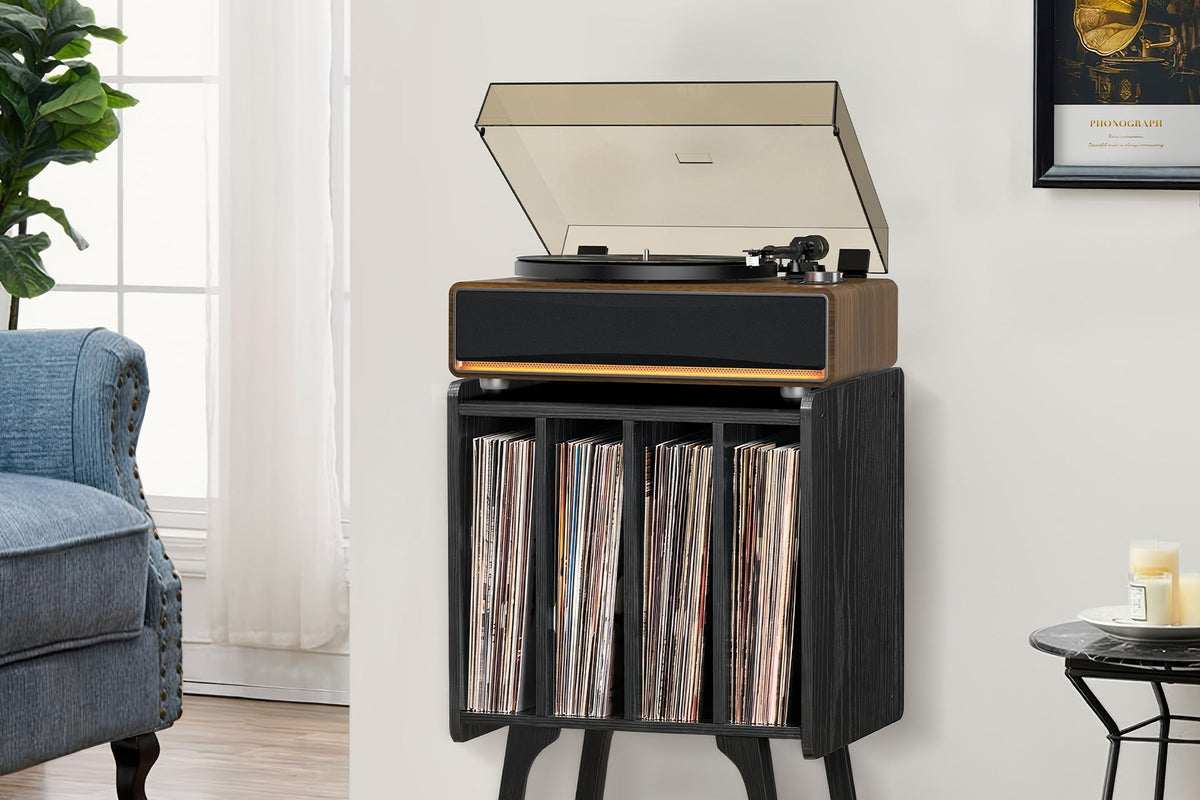
Add a record stand if you want the album you're playing to become part of the room.
And if you also listen to CDs, choose speakers with enough inputs to accommodate a second source.
The result is a listening setup that doesn't require an entire wall—or a dedicated listening room.
The Best Speakers Are the Ones That Fit
There is no universal “best speaker” for a vinyl setup.
The right choice depends on your room, listening distance, volume preferences, connections, and how much equipment you actually want around you.
For a small room, simplicity is often a strength.
Choose speakers that fit the space, connect easily to your turntable, and make you want to sit down and listen.
You don't need a massive stereo system to make vinyl part of your everyday life. Sometimes a turntable, two well-placed speakers, and a comfortable chair are more than enough.






Leave a comment
All comments are moderated before being published.
This site is protected by hCaptcha and the hCaptcha Privacy Policy and Terms of Service apply.